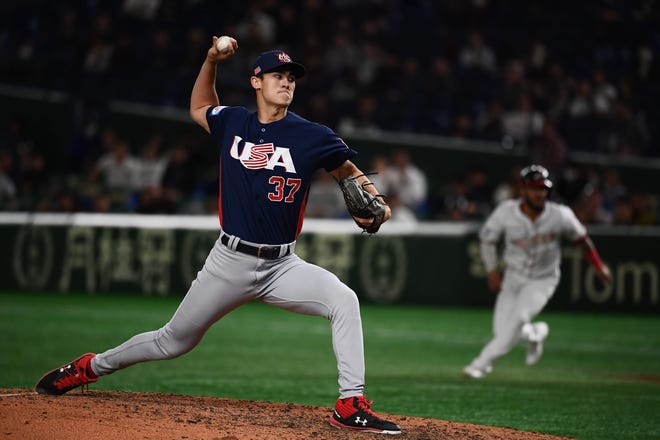
Red Sox prospect Noah Song has received his marching orders and will report to flight school in Pensacola no later than June 26th, according to The Capital Gazette’s Bill Wagner.
Per Wagner, the order for Song to report to flight school was handed down by the Department of Defense, and it comes about eight months after the California native submitted a request to the DoD “seeking a transfer to the Navy Reserve so he could continue his professional baseball career during the 2020 season.”
However, after waiting quite a while for a response to that request, Song in April “submitted an updated request to pursue flight training after all.”
The 2019 fourth-round pick graduated from the Naval Academy last May and was allowed to play two months of minor-league baseball with the short-season Lowell Spinners over the summer.
Song was impressive in that stretch, as he emerged as the Red Sox’ sixth-ranked prospect by posting a 1.06 ERA and .167 batting average against over seven starts and 17 innings pitched for Lowell.
Despite the success he had to kick off his professional career, both with Lowell and Team USA in last fall’s Premier 12 tournament, Song will have to put his major-league aspirations on hold for the time being.
As Wagner puts it, “Training to be designated as a naval flight officer typically lasts approximately 18 months. It begins with aviation indoctrination at Naval Air Station Pensacola and continues with specialized training for whichever aircraft platform the service member is assigned.
“If Song’s training starts this summer, he would not be designated as a naval flight officer until sometime in 2022. However, he could receive his wings as an aviator after about a year of training.”
It does seem like the former is more likely than the latter in this case, though, so the next time we see Song, who turned 23 in May, with the Red Sox in some capacity will probably be sometime in 2022.
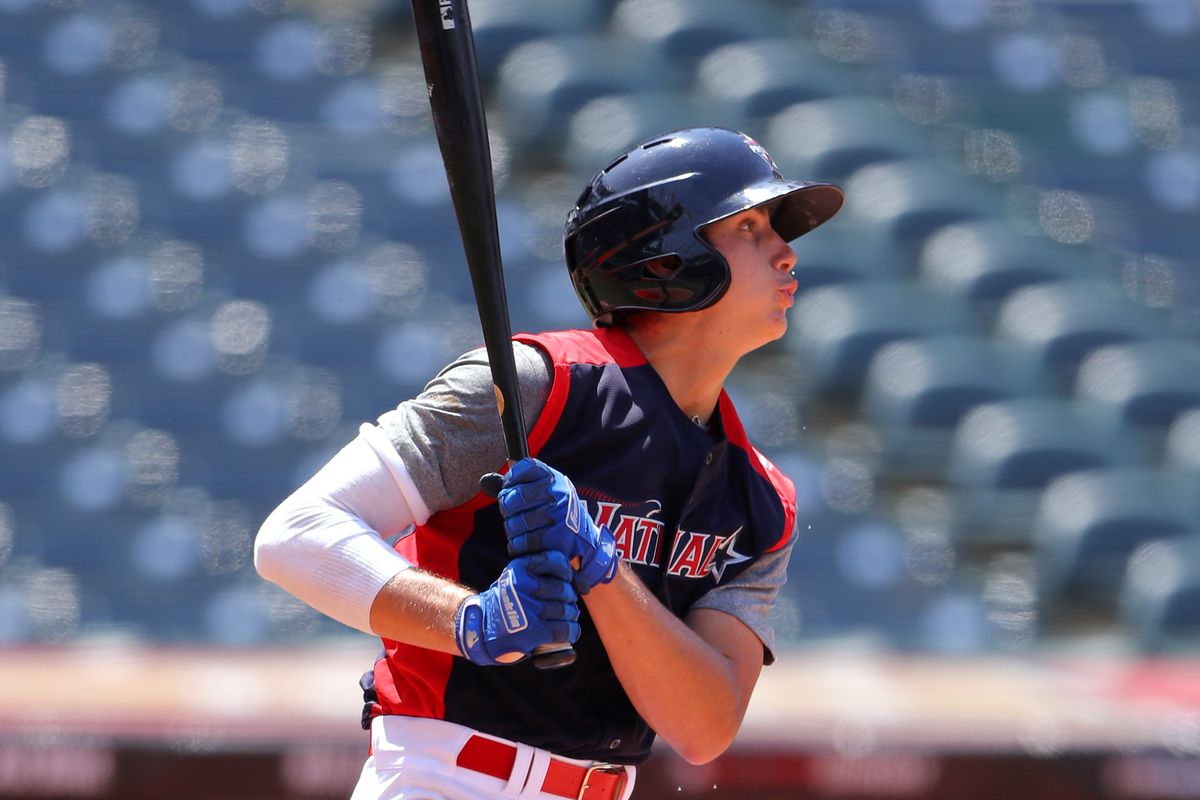
In their latest 2020 five-round mock draft, the folks over at Perfect Game have the Red Sox taking high school catcher Tyler Soderstrom with their top pick at No. 17 overall.
Perfect Game national scouting director Jered Goodwin writes the following of Soderstrom:
The left-handed hitting catcher raked all summer on the showcase circuit, including the Perfect Game All American Classic. He is athletic enough and the arm plays so there is reason to believe he can stay behind the plate, long term. His average/power potential from the left side is the carrier, however, with impact offensive upside in the cards here.
Ranked by MLB Pipeline as the No. 19 overall prospect in this year’s draft class, Soderstrom, who turns 19 in November, is committed to play college baseball at University of California, Los Angeles.
The Turlock High School (Calif.) product is listed at 6’2″ and 200 lbs. and hits from the left side of the plate.
Per his MaxPreps page, Soderstrom slashed .373/.458/.569 with seven home runs, 21 doubles, and 69 RBI over 82 total games played in high school dating back to the beginning of his freshman season.
The son of former 1993 first-round pick Steve Soderstrom, Tyler is “a hitter first, but he will get to his power. He might be a tick above average as a runner, especially for a catcher, and has shown he has the athleticism to play third and even the outfield,” according to MLB Pipeline.
It’s been reported several times in the past few weeks that the Red Sox are likely leaning towards taking a high school prospect with their top pick in this year’s draft as they pursue prospects with plenty of upside.
Soderstrom is just one of several prep prospects who have been linked to Boston in recent mock drafts. Right-handers Nick Bitsko and Mick Abel, shortstop Ed Howard, and outfielders Robert Hassell, Pete-Crow Armstrong, and Austin Hendrick are among the others.
Under chief baseball officer Chaim Bloom and amateur scouting director Paul Toboni, the Sox will have approximately $5,129,200 to spend on the four selections they will be making in the 2020 draft, which is only five days away.
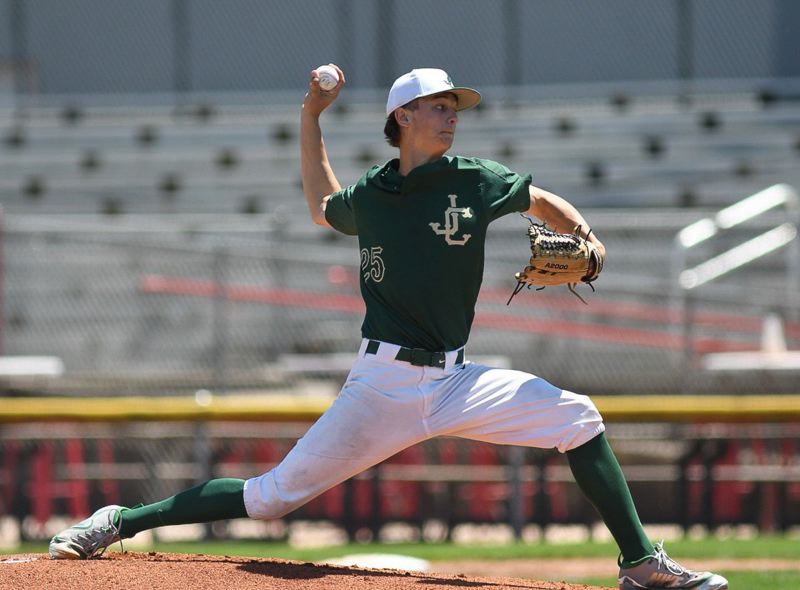
In his latest 2020 mock draft for MLB.com, Jim Callis has the Red Sox taking high-school right-hander Mick Abel with their top pick at No. 17 overall.
You can read more about Abel, an 18-year-old out of Oregon, here, but what I found most interesting about Callis’ write-up on the righty was how he also linked two more draft-eligible prospects to the Red Sox in Pete Crow-Armstrong and Ed Howard.
“The Red Sox don’t appear to be going conservative despite losing their second-round choice for sign stealing,” Callis wrote. “Because they’re also in on Crow-Armstrong and Howard.”
Starting with Crow-Armstrong, the 18-year-old outfielder, listed at 6’1″ and 180 lbs., out of Harvard-Westlake High School in Los Angeles is ranked as MLB Pipeline’s No. 20 draft-eligible prospect.
Harvard-Westlake is regarded as one of the best baseball schools in the country, producing major-league talents such as Lucas Giolito, Jack Flaherty, and Max Fried in recent years.
Per his Prospects Live scouting report, Crow-Armstrong “is more quick than fast, but has elite instincts in center field with an above average arm and projects as an elite defensive value. He has shown more swing and miss than expected, but has a simple clean swing and his diamond kinetics is full of truly electric bat speed metrics that portend to more future power.”
Crow-Armstrong, who bats from the left side of the plate, was a member of Team USA in the U-18 Baseball World Cup last summer in South Korea, where he slashed .364/.405/.606 with four stolen bases and nune runs scored over nine games played.
Callis has the young outfielder going to the Diamondbacks with the 18th overall pick in his aforementioned mock draft.
It’s also worth mentioning that Crow-Armstrong is committed to play at Vanderbilit.
—
As for Howard, MLB Pipeline’s 15th-ranked draft-eligible prospect is regarded by Callis as “the best true shortstop in the draft.”
The 18-year-old out of Lynwood, Ill. hits from the right side of the plate, and according to Baseball America, “throws well from most angles and has the short-area quickness and range that scouts like to see from a shortstop.”
Listed at 6’2″ and 185 lbs., Howard “has a high floor for a prepster as a reliable performer with the chance for solid tools across the board,” per Callis.
Howard is a University of Oklahoma commit.
—
The 2020 MLB Draft is less than four weeks away and will be limited to just five rounds.
Due to their sign stealing in 2018, the Red Sox will be limited to just four draft picks in what will be chief baseball officer Chaim Bloom’s first draft at the helm in Boston.
The assigned slot value for the 17th overall pick in this year’s draft is approximately $3,609,700, so that’s how much bonus money the Sox will have to work with to sign whoever they select with the pick.
According to my calculations, up to 10 prospects, including Crow-Armstrong and Howard, have been projected to land with the Red Sox in the first round of this year’s amateur draft.
At this point, if the Sox do not take one of Crow-Armstrong, Howard, Abel, Chris McMahon, Robert Hassell, Nick Bitsko, Patrick Bailey, Tanner Burns, Garrett Crochet, or Heston Kjerstad with the 17th overall pick, I will be somewhat surprised. But, what do i know?
For more draft-related content, check out the following links below:
In his latest mock draft for Prospects365.com, Mason McRae has the Red Sox taking high school right-hander Mick Abel with the 17th overall pick in this year’s June draft.
.@mason_mcrae released his first MLB Mock Draft for P365. 🔥
It includes all first round picks with write-ups + organizational philosophies for each selection. 👀
As we now know, the 2020 MLB Draft will be just five rounds, the shortest in the sport’s histroy, making hitting on the early picks that much more important for Red Sox chief baseball officer Chaim Bloom and company. The club will have $3,609,700 to spend on their first selection.
Per his Baseball America scouting report, Abel, an 18-year-old out of Jesuit High School in Oregon, “has touched 97 MPH at times with his fastball, but didn’t get to that regularly last summer. He also mixes in one of the better breaking balls of the amateur class, and has good feel for a changeup that could give him three plus offerings.”
Listed at 6’5″ and 190 lbs., the Oregon State University commit started two games for Team USA in last summer’s U-18 Baseball World Cup in South Korea, allowing four earned runs over 4 1/3 total innings of work in those appearances.
A pitching arsenal that includes a 60-grade fastball, a 55-grade slider and changeup, and a 50-grade curveball, Abel is “only going to get stronger and throw harder as he physically matures, something he showed a glimpse of in one outing this spring before things got shut down [due to the coronavirus pandemic],” according to MLB Pipeline.
McLean or “Mick,” is expected to be one of the first prep pitchers taken off the board in this year’s draft, so it will be interesting to see if he is still available when the Red Sox are on the clock with the No. 17 pick.
The 2020 MLB Draft will indeed only be five rounds, according to The Athletic’s Ken Rosenthal. The draft will be held June 10th, its original start date, and June 11th.
Amateur draft will be five rounds, sources tell me and @EvanDrellich. Teams can sign unlimited number players after that for $20,000 each. Also reporting: @JeffPassan.
Upon completion of this year’s amateur draft, clubs can sign an unlimited number of undrafted players for a signing bonus of up to $20,000 each.
The five-round draft will be the shortest in the sport’s history, and as The Athletic’sJayson Stark notes, that means that over 1,000 draft-eligible prospects who thought they were going to be drafted as recently as January won’t.
That being the case because under normal circumstances, the draft would be 40 rounds. However, due to the pandemic-induced shortened 2020 season, Major League Baseball and the MLBPA reached an agreement back in March to shorten the draft from anywhere between 5-10 rounds.
In a proposal sent to the MLBPA from commissioner Rob Manfred’s office earlier in the week, a 10-round draft would come “with other trade-offs that the Players Association determined were too restrictive, including slot amounts in rounds 6-10 at half their 2019 values and a limit of five undrafted players who could sign for a $20,000.” The union rejected the proposal.
If their had been five additional rounds in this year’s draft, the slot values of those rounds would have only come out to approximately $29,578,100, per ESPN’s Jeff Passan. In other words, less than $1 million per club, which has disappointed many across the game.
The Red Sox this year will make their first selection in this year’s draft with the 17th overall pick. That pick will have a slot value of $3,609,700.
Boston will be without a second-round pick as part of their punishment for stealing signs in 2018, but here are the rest of the slot values for the club’s third, fourth, and fifth-round picks, courtesy of Baseball America.
Round 3, 89th overall: $667,900
Round 4, 118th overall: $487,900
Round 5, 148th overall: $364,400
Again, the 2020 MLB Draft will begin on June 10th, and it will be held virtually, presumably on MLB Network.
The start date and length of the 2020 MLB first-year player draft may both be unknowns at this point in time, but that’s not stopping clubs from doing their due diligence ahead of the annual amateur selection process.
After not having any first-round picks last year due to luxury tax-related penalties from 2018, the Red Sox are slated to make their first selection with the 17th overall pick in this year’s draft. That being the case because at 84-78, Boston finished with the 17th-worst record in baseball last season.
According to Baseball America, the 17th overall pick in the 2020 draft has an assigned slot value of approximately $3,609,700, meaning that’s how much money the Sox will have to spend on that pick, although they can go over that allotted amount if they are willing to incur some tax penalties.
Personally, I’m no draft expert, but since the 2020 MLB Draft is right around the corner, I thought it would be a good idea to look into who Red Sox chief baseball officer Chaim Bloom and Co. could be targeting in the earliest stage of this year’s draft. Let’s get into it.
Target No.1: RHP Nick Bitsko, Central Bucks High School East (Doylestown, PA)
In his mock draft from April 15th, CBS Sports’ Mike Axisa had the Red Sox taking high school right-hander Nick Bitsko out of Doyleston, Pa.
Bitsko, 17, was initially set to graduate from Central Bucks High School East in 2021, but he will instead graduate early, adding on to an already impressive list of draft-eligible pitching prospects this year.
A University of Virginia commit, Bitsko posted a 1.18 ERA over six starts during his sophomore season last year, per MaxPreps.
According to a Baseball America scouting report from 2019, “Bitsko has a great pitcher’s frame, standing at 6-foot-4, 220-pounds and has a smooth and easy operation on the bump, with an overhead windup and clean three-quarter slot.”
From that same scouting report, Bitsko’s arsenal includes a 92-96 MPH fastball, a 76-83 MPH curveball, and an 86-87 MPH “firm” changeup.
If drafted by the Red Sox over the summer, Bitsko would presumably become one of the top right-handed pitching prospects in the organization, although there certainly are some minor concerns given just how young he is and how he didn’t get the chance to really throw in front of scouts this year.
Target No. 2: C Patrick Bailey, North Carolina State University
Moving to the college ranks now, Dan Zielinski III of the Baseball Prospect Journal has the Red Sox taking North Carolina State backstop Patrick Bailey in his latest first-round mock draft.
The 20-year-old out of Greensboro was drafted by the Twins in the 37th round of the 2017 draft, but he opted to honor his commitment to North Carolina State instead, and it looks like that decision is going to pay off for him.
Although he played in just 17 games for the Wolfpack this year due to the college baseball season being shut down last month, Bailey produced over the course of that small sample size, as he slashed .296/.466/.685 with six home runs and 20 RBI.
Per a March scouting report from Perfect Game USA, Bailey “has significant value as a switch-hitting catcher with pop on both sides of the plate to go along with strong defensive skills.”
If taken by the Red Sox this summer, I would guess that Bailey would slide behind Connor Wong as the second-best catching prospect in Boston’s farm system.
Target No. 3: RHP Tanner Burns, Auburn University
The first college hurler on this list, My MLB Draft’s most recent 2020 mock from earlier in the month has the Red Sox taking Auburn right-hander Tanner Burns in the first round.
Another former 2017 37th-round pick, Burns was limited to just four starts and 22 1/3 innings pitched this season due to the aforementioned shutdown. In those four starts though, the 21-year dazzled by posting a 2.42 ERA and averaging nearly 13 strikeouts per nine innings.
Listed at 6’1″ and 205 lbs., MLB Pipeline has Burns ranked as their No. 28 draft prospect. They describe the junior as a hurler, who “can work at 92-97 mph with his fastball and locate it to both sides of the plate. His breaking ball can be a plus pitch at times, combining slider velocity in the low 80s with curveball depth, but it gets slurvy at others. He hasn’t had much need for his changeup, though it has some sink and shows some signs of becoming an average third pitch.”
Burns also comes with some durability concerns, as he dealt with right shoulder soreness throughout the majority of his sophomore season in 2019.
Like Bitsko, Burns would presumably become one of the top right-handed pitching prospects in the Sox’ farm system if he is drafted by Boston at some point this summer.
Target No. 4: LHP Garrett Crochet, University of Tennessee
Sticking with the Southeastern Conference here, Prospects Live has the Red Sox selecting University of Tennessee southpaw Garrett Crochet in their 2020 Mock Draft 2.0.
A native of Mississippi who turns 21 in June, Crochet was only able to make one start for the Volunteers this year due to upper back soreness. To add on to that, the left-hander broke his jaw last May after taking a line-drive to the face in his final start of the 2019 regular season that resulted in him missing two weeks of action.
According to a Prospects Live scouting report from Crochet’s lone outing of the 2020 campaign against Wright State in March, the junior’s pitch arsenal included a fastball that sat around 95-97 MPH and maxed out at 99 MPH, an 84-86 MPH slider, an 80-90 MPH changeup, and an 80 MPH curveball.
MLB Pipeline has Crochet ranked as their 18th-best draft-eligible prospect, so he could very well still be on the board by the time the Red Sox make their first pick at No. 17.
Target No. 5: OF Heston Kjerstad, University of Arkansas
Last but not least, we have the lone outfielder on this list in the University of Arkansas’ Heston Kjerstad, who Perfect Game USA’s Brian Sakowski has going to the Red Sox in the first round of his most recent 2020 mock draft from late last month.
The Amarillo, Texas native did nothing but rake in his three seasons as a Razorback, putting together a .343/.421/.590 slash line to go along with 37 home runs and 129 RBI over 150 total games dating back to 2018.
Sakowski’s scouting report for Kjerstad looks a little something like this:
“The left-handed slugger has double-plus raw pop along with the bat speed and impact generation to crush balls with wood. There are some positional questions long-term, but the Red Sox have shown the willingness to take prospects with big power and figure out how to get them into the lineup later.”
MLB Pipeline has Kjerstad ranked as their 10th-best prospect in this year’s draft, so he might not even be on the board by the time the Red Sox make their first selection at No. 17, but if he is, and the Sox take him, that would be quite the addition to an already fascinating mix of outfield prospects that includes Jarren Duran, Marcus Wilson, and Gilberto Jimenez to name a few.
—
Well, there you have it. Five prospects the Red Sox could take with the 17th overall pick in the 2020 first-year player draft. If they do wind up taking one of these five young players with their first pick, you can come back here and remember that I had it first.
Also, the 17th overall pick is the lowest first-round pick the Red Sox have had since 2016, so it’s probably important that they hit on it in order to improve a poorly-regarded, but steadily-improving farm system.
You ever visit those fantasy sports sites like ESPN or FantasyPros and notice how they compile their rankings into one elaborate chart that curates information from multiple sources/analysts? Well, I decided to do that with the top 30 prospects in the Red Sox farm system.
There might not even be any minor-league baseball played this year due to the coronavirus pandemic in the United States, but I thought it would nonetheless be interesting to compare how different sites–MLB Pipeline, SoxProspects, and FanGraphs–view the top talent that Boston has to offer at the minor-league level.
The following Red Sox prospects were ranked by one of the aforementioned three sites, but not the other two: SS Ceddanne Rafaela, 1B Pedro Castellanos, OF Bryan Gonzalez, OF Eduardo Lopez, OF Juan Chacon, and C Naysbel Marcano.
Prospects Danny Diaz and Tyler Esplin, meanwhile, were ranked by two of the aforementioned sites and left off by the other. They made the list.
Prospect
MLB Pipeline
SoxProspects
FanGraphs
Average
IF Jeter Downs
1
2
1
1.33
1B/3B Triston Casas
2
1
2
1.67
RHP Bryan Mata
4
3
3
3.33
1B/3B Bobby Dalbec
3
6
4
4.33
OF Gilberto Jimenez
5
5
6
5.33
RHP Noah Song
6
9
5
6.67
OF Jarren Duran
8
7
10
8.33
LHP Jay Groome
7
4
15
8.67
RHP Tanner Houck
10
8
9
9
RHP Thad Ward
9
11
11
10.33
SS Matthew Lugo
11
15
7
11
OF Nick Decker
12
17
14
14.33
IF Cameron Cannon
17
18
8
14.33
IF C.J. Chatham
13
10
21
14.67
C/IF Connor Wong
16
12
16
14.67
RHP Brayan Bello
18
19
12
16.33
IF Brainer Bonaci
14
20
18
17.33
RHP Chih-Jung Liu
15
27
13
18.33
SS Antoni Flores
19
21
17
19
LHP Chris Murphy
20
16
23
19.67
RHP Ryan Zeferjahn
22
13
29
21.33
3B Brandon Howlett
23
25
20
22.67
OF Marcus Wilson
21
23
25
23
RHP Aldo Ramirez
27
14
31
24
IF Jonathan Arauz
30
28
22
26.67
RHP Durbin Feltman
25
29
28
27.33
IF Danny Diaz
24
32
NR
28
RHP Andrew Politi
26
37
27
30
LHP Yoan Aybar
29
31
34
31.33
OF Tyler Esplin
28
60
NR
44
So, to boil it all down, here’s a more simplified top-30 list based off the math you see in the chart above.
IF Jeter Downs
1B/3B Triston Casas
RHP Bryan Mata
1B/3B Bobby Dalbec
OF Gilberto Jimenez
RHP Noah Song
OF Jarren Duran
LHP Jay Groome
RHP Tanner Houck
RHP Thad Ward
SS Matthew Lugo
OF Nick Decker
IF Cameron Cannon
IF C.J. Chatham
C/IF Connor Wong
RHP Brayan Bello
IF Brainer Bonaci
RHP Chih-Jung Liu
SS Antoni Flores
LHP Chris Murphy
RHP Ryan Zeferjahn
3B Brandon Howlett
OF Marcus Wilson
RHP Aldo Ramirez
IF Jonathan Arauz
RHP Durbin Feltman
IF Danny Diaz
RHP Andrew Politi
LHP Yoan Aybar
OF Tyler Esplin
In total, 26 of the above 30 players were either drafted or signed by the Red Sox, while three were traded for, and one was acquired in the Rule 5 Draft.
For more in-depth analysis, information, and scouting reports on these prospects and even more players, check out one of the sites I used for this piece in SoxProspects.com. Those guys do a great job in covering the Red Sox farm system. You can even read more abut them and how they got their start here.
The Pawtucket Red Sox, Portland Sea Dogs, Salem Red Sox, and Greenville Drive should all be a little more than two weeks into their season right about now.
Instead, the COVID-19 pandemic has put the baseball season, major and minor-league alike, on hold for the time being.
Recently, there have been reports about Major League Baseball potentially putting together a plan that would involve having all 30 clubs play their games this season in one central location, such as Arizona, Florida, or even Texas.
As encouraging as those proposals may seem, what has not been discussed much since MLB suspended spring training last month is when the minor-league season will start, or if there will even be one at all.
According to Baseball America’s J.J. Cooper, “In off-the-record discussions with people all around the game, there is a near-universal acknowledgement that there are a massive amount of hurdles that have to be overcome to make any MiLB season happen.”
Cooper gets into more of the financial and logistical side of things in his article, but in this case, I want to focus on the developmental side. More specifically, if no minor-league games are played in 2020, how would that impact a prospect’s development and career trajectory?
Take Red Sox infield prospect Jeter Downs for instance. The top prospect acquired by Boston from the Dodgers in the Mookie Betts and David Price trade is projected by FanGraphs to make his big-league debut at some point during the 2022 campaign. Would having no minor-league games to play in this year result in Downs’ ETA being pushed back another year?
That probably still depends on what the 21-year-old does in 2021, but taking away a year to develop and continue to improve in actual games while being under the eyes of the organization is something worth thinking about nonetheless.
As odd as it would be to see MLB games played in front of no fans in one neutral location this year, it might be even weirder to have no minor-league baseball to look forward to in 2020 at all.
As part of their punishment for illegally stealing signs in 2018, the Red Sox on Wednesday were docked a second-round pick in this year’s first-year player draft.
That may not sound too significant on the surface, but when you consider that the 2020 MLB Draft will only be anywhere between 5-10 rounds to cut back on spending, it becomes that much larger of a hurdle.
Red Sox chief baseball officer Chaim Bloom echoed that same sentiment when speaking with reporters via a conference call earlier Wednesday evening.
“The potential limitations on the draft this year just makes that punishment larger” he said. “It’s significant.”
According to Baseball America, the Sox were slated to make their second-round pick in this year’s draft with the 52nd overall selection, so all that means is the chance to continue to improve a poorly-regarded farm system has in part been taken away.
Some notable prospects the Red Sox have drafted in the second round of past drafts include Jon Lester, Dustin Pedroia, Justin Masterson, Alex Wilson, Brandon Workman, and Sam Travis.
The loss of a second-round pick in this year’s draft comes a year after the Sox were without a first-round selection in the 2019 draft. That was due to luxury tax-related penalties, though, and they wound up taking infielders Cameron Cannon and Matthew Lugo with their first two selections in the second round.
The exact date of the start of the 2020 draft is not even known at this point. It could begin as soon as June 10th or as late as July 20th. It’s anyone’s guess, really.
On another note, I’m planning on writing something up on who Bloom and Co. could target in the first round of the 2020 draft (Red Sox have the 17th pick), so stay tuned for that in the coming days.
Four days after making their first round of spring roster cuts, the Red Sox cut 15 more players before taking on the Minnesota Twins earlier Sunday.
Out of those 15 players, eight were reassigned to minor-league camp, five were optioned to Triple-A Pawtucket, one was optioned to Double-A Portland, and one was optioned to High-A Salem.
The players who were reassigned to minor-league camp were cathcer Roldani Baldwin, catcher/infielder Connor Wong, infielder Jeter Downs, first baseman Josh Ockimey, right-handed pitchers R.J. Alvarez, Trevor Hildenberger, and Tanner Houck, and left-handed pitcher Mike Kickham.
The players optioned to Triple-A Pawtucket were infielders Bobby Dalbec and C.J. Chatham, right-handers Mike Shawaryn and Phillips Valdez, and left-hander Kyle Hart.
Outfielder Marcus Wilson was the lone player optioned to Double-A Portland, while right-hander Yoan Aybar was the lone player optioned to High-A Salem.
In total, seven players — Aybar, Chatham, Dalbec, Hart, Shawaryn, Valdez, Wilson — on Boston’s 40-man roster were cut from big-league camp on Sunday.
Out of the 14 non-roster invites still in major-league camp, the most notable are Brian Johnson, Jonathan Lucroy, Marco Hernandez, and Jarren Duran. Take away Duran and the other three are certainly vying for positions on Boston’s 26-man roster to open the season.
Some thoughts:
Seeing the two prospects the Red Sox acquired in the Mookie Betts and David Price trade get cut is not much of a surprise, but it is a bit surprising seeing names like Kyle Hart, Tanner Houck, and Mike Shawaryn be cut at this point in time.
At least in my mind, I thought Hart and Houck were candidates to fill the two vacant spots in the Sox’ starting rotation, while Shawaryn was competing for a bullpen role. Instead of beginning the year in the majors though, it looks like the trio of hurlers will start with the PawSox.
Guys like Chatham and Dalbec probably had an outside chance of making Boston’s Opening Day roster before Sunday, but if we do see them in the majors this season, it will have to come at a later date.
On a final note, I’m looking forward to seeing what Marcus Wilson does in his first full year in the Red Sox organization.


 Blogging the Red Sox