Red Sox take Stanford infielder Tommy Troy with top pick in Keith Law’s first 2023 mock draft

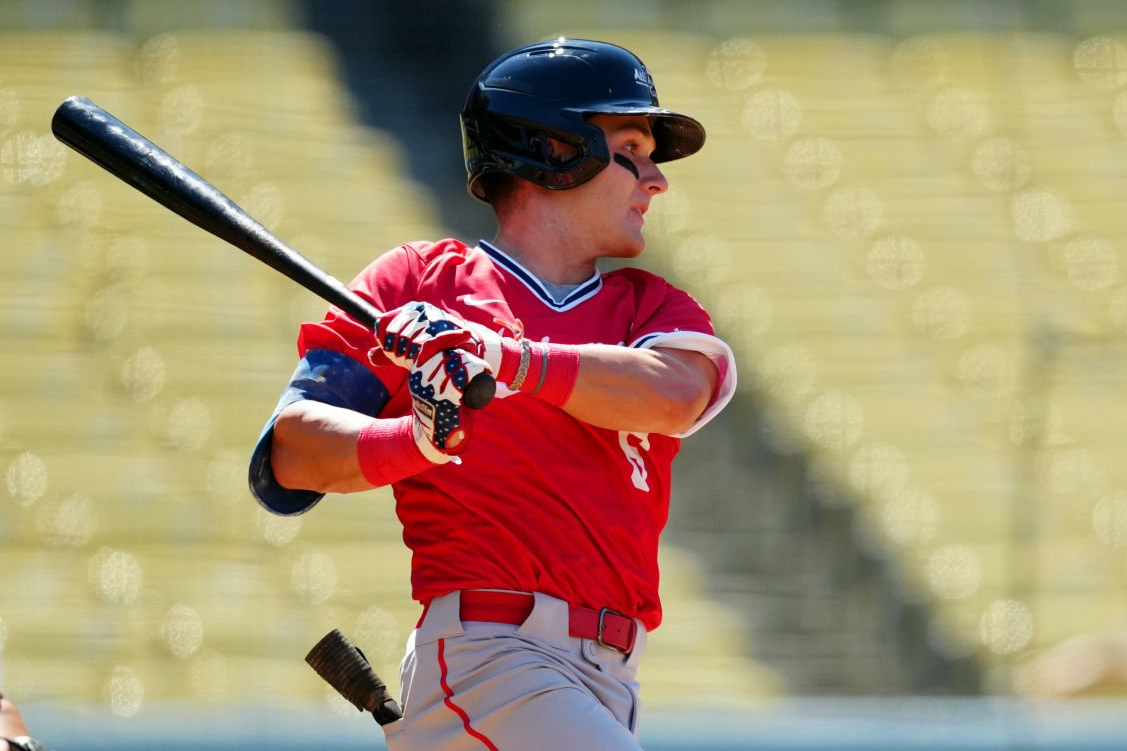
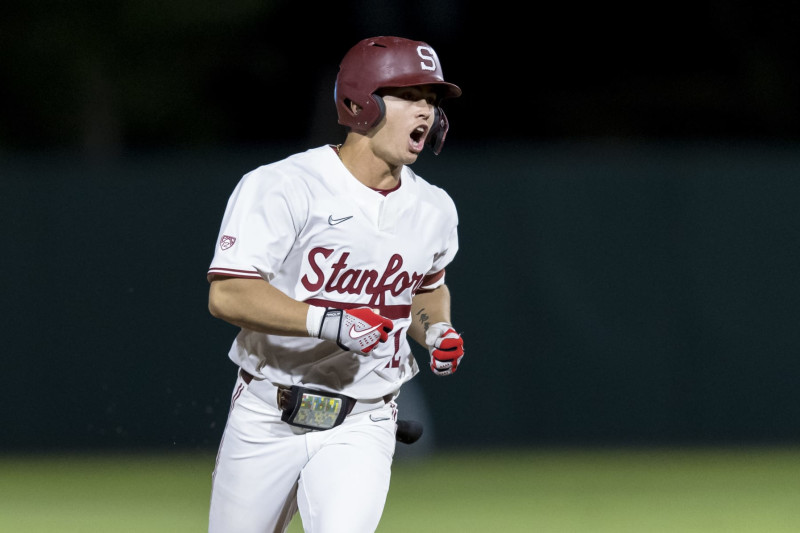
In his first mock draft of the year for The Athletic, Keith Law has the Red Sox taking Stanford shortstop Tommy Troy with the 14th overall pick in the 2023 amateur draft.

“I think this is pretty open, with any of the guys I have just ahead of Boston’s pick also possibilities, as well as [Matt] Shaw,” Law wrote on Wednesday. “I could see the Red Sox being in on Kevin McGonigle given their predilection for high school hitters with potential plus hit tools with their first picks in 2020 (Nick Yorke) and 2022 (Mikey Romero).”

Troy came in as the No. 16 draft-eligible prospect in Law’s latest rankings, which were released earlier this month. Baseball America also has the 21-year-old infielder at No. 16 in its rankings while MLB Pipeline places him 20th on its most updated list.

A right-handed hitting junior, Troy batted a stout .404/.485/.720 with 14 doubles, four triples, 13 home runs, 43 RBIs, 61 runs scored, 16 stolen bases, 26 walks, and 29 strikeouts in 45 games (227 plate appearances) for Stanford this season. On the heels of such a productive campaign, the Los Gatos, Calif. native was named the Pac-12 batting champion on Tuesday.

Defensively, Troy has proven to be quite versatile over the course of his amateur career. With the Cotuit Kettleers of the Cape Cod Baseball League last summer, for instance, the 5-foot-10, 197-pounder saw playing time at both shortstop and second base. He also has past experience in the outfield, though he did play a lot of third base for the Cardinal this spring.

“He’s a plus runner who has played all three skill positions on the infield, but I think someone has to send him out as a shortstop and let him prove he can’t stay there,” Law wrote of Troy’s defensive capabilities. “If he’s not a shortstop, he has a harder path to everyday play, so giving him that chance is key to creating some upside.”

Per his MLB Pipeline scouting report, “Troy’s standout tool is his ability to make consistent, hard contact from the right side of the plate. He has impressive bat-to-ball skills and rarely strikes out or chases out of the zone, showing excellent pitch recognition, though there are some moving parts of his swing. There’s enough extra-base pop in there for there not to be concerns about impact at the next level and he could have average power in the future. He’s answered some concerns about his approach and lack of walks by being more selective in 2023.”

Troy, who does not turn 22 until next January, still has some baseball left to play before preparing for the draft. Stanford, which earned the top seed in its conference, opened Pac-12 tournament play against California on Wednesday night. DraftKings Sportsbook currently has the Cardinal with the fifth-best odds to win the 2023 College World Series at +1500.

The Red Sox landed the 14th overall pick in this year’s draft in the first-ever MLB Draft Lottery back in December. Boston has not used a first-round selection on a college position player since taking Andrew Benintendi out of Arkansas in 2015.

Back then, the 14th overall pick came with an attached slot value of $2,482,400. This year, the pick is valued at $4,663,100, which represents approximately 45.3 percent of the Red Sox’ $10,295,100 bonus pool.

The 2023 MLB Draft gets underway in Seattle on July 9, or six weeks from this coming Sunday. It will consist of 20 rounds and run through the final day of All-Star festivities at T-Mobile Park.

(Picture of Tommy Troy: AP Photo/John Hefti)
First MLB Pipeline mock draft of 2023 has Red Sox taking Florida righty Hurston Waldrep

The Red Sox have not used a first-round draft pick on a college pitcher since 2017. Could that change this summer?

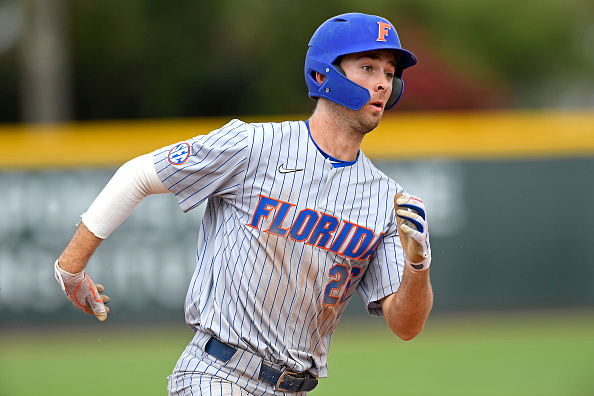
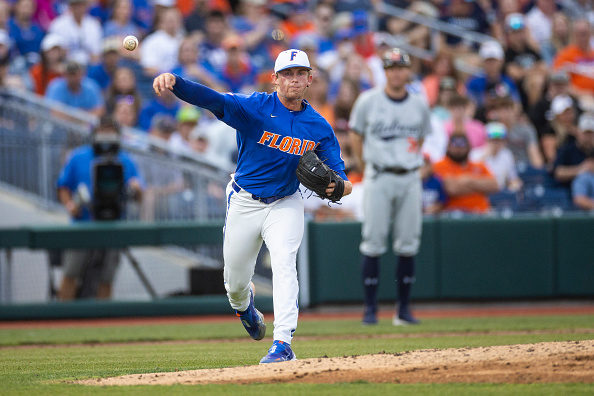
In his first mock draft of the year for MLB.com, Jim Callis of MLB Pipeline has the Red Sox taking Florida right-hander Hurston Waldrep with the 14th overall pick in the 2023 amateur draft.

Waldrep, 21, is currently regarded by MLB Pipeline as the No. 11 draft-eligible prospect, which ranks fourth among pitchers in this year’s class. The junior righty owns a 5.07 ERA and 1.45 WHIP with 102 strikeouts to 40 walks in 12 starts (65 2/3 innings) for the Gators so far this season. Opponents are batting .227 against him.

A native of Georgia, Waldrep began his college career at Southern Mississippi after going undrafted out of Thomasville High School in 2020. He compiled a 3.22 ERA in two seasons with the Golden Eagles before transferring to Florida last July.

Standing at 6-foot-2 and 210 pounds, Waldrep operates with “a legitimate three-pitch power mix, with all three offerings having the potential to be at least above-average,” per his MLB Pipeline scouting report. He sits between 95-99 mph with his four-seam fastball, which is complemented by a whiff-inducing split-changeup and an upper-80s slider.

Mechanically, there are some concerns when it comes to Waldrep’s delivery. MLB Pipeline notes that “while Waldrep is generally around the strike zone, there is a little effort in his up-tempo delivery, causing some inconsistencies with his command and control, which led to an uptick in his walk rate this spring.”

To that end, Waldrep had an uneven start for the Gators on Saturday. Going up against Texas A&M on the road, he allowed four earned runs on two hits and five walks to go along with a season-high six walks over three innings of work in a 15-2 loss to the Aggies.

Because of those aforementioned command issues, Waldrep could project as a reliever as opposed to a starter in the long-run. Even so, Waldrep will almost certainly come off the board early on account of his potential and arsenal. Whichever team drafts him will probably do so with the idea that they can help him throw strikes more consistently.

The last time the Red Sox took a college pitcher in the first round of a draft was 2017, when righty Tanner Houck was selected out of Missouri at No. 24 overall. Since Chaim Bloom took over as Boston’s chief baseball officer in late 2019, the club has exclusively drafted high school infielders (Nick Yorke, Marcelo Mayer, and Mikey Romero) with their top pick.

The Red Sox landed the 14th overall pick in this year’s draft in the first-ever MLB Draft Lottery back in December. It did not come as much of a surprise since Boston finished with the 14th-worst record in baseball last season.

The 14th overall pick in the 2023 draft, which takes place from July 9-11, comes with a slot value of $4,663,100 (up from $4,243,800 last year). The Red Sox as a team have a bonus pool of $10,295,100.

(Picture of Hurston Waldrep: James Gilbert/Getty Images)

First Baseball America mock draft of 2023 has Red Sox taking prep infielder Kevin McGonigle with top pick

In their first mock draft of the year, Baseball America has the Red Sox taking prep infielder Kevin McGonigle with their top pick at No. 14 overall.

McGonigle, 18, is currently regarded by Baseball America as the 21st-ranked prospect in this year’s draft class. The left-handed hitting shortstop is coming off a junior season with Monsignor Bonner High School (Drexel Hill, Pa.) in which he batted .457/.582/.975 with five doubles, two triples, 11 home runs, 32 RBIs, 47 runs scored, 10 stolen bases, 21 walks, and two strikeouts in 27 games (110 plate appearances) for the Friars.

According to his Baseball America scouting report, McGonigle ” has a stellar offensive track record and dominated the travel ball circuit in both 2021 and 2022, on top of performing well against New Jersey high school competition and with Team USA’s 18U National Team. The consistency of his at-bats and production, no matter the competition, places him as one of the best pure hitters in the class.”

On the other side of the ball, 5-foot-11, 185-pounder is described as being “a high-IQ player who is more likely to be a steady defender than a flashy, impactful one. A shortstop now, McGonigle has turned in some above-average run times, but is more of a fringy or below-average runner out of the box. That lack of range could make him a better fit for second base, where he has solid hands, fluid defensive actions and requisite arm strength for the position.”

Because of his offensive and defensive profile, McGonigle has drawn comparisons to other talented, yet undersized infield prospects who went in the first round of their respective drafts, such as the Mariners’ Cole Young or the Yankees’ Anthony Volpe. McGonigle himself has said that he models his game after Phillies legend Chase Utley.

As for why Baseball America projects the Red Sox to take McGonigle in this summer’s draft, one scout writes that the Philadelphia-area native ” has one of the best hit tools in the high school class, which the Red Sox have seemingly prioritized in recent years at the top of the draft.”

Draft writer Carlos Collazo concurs with the scout’s point, noting that Boston has used its last three first-round picks on high school infielders with plus hit tools in Mikey Romero (2022), Marcelo Mayer (2021), and Nick Yorke (2020). The only difference between these three and McGonigle is that the latter does not call California home.

McGonigle, who does not turn 19 until August, signed his letter of intent to play college baseball at Auburn University last November. At that time, he told Dawn Timmery of Fox 29 Philadelphia: “I think going to Auburn is going to help me mature more and get better at the game. It would be a great opportunity to go to the MLB and play with a team. We’ll see what happens in the future.”

As of now, the slot value for the 14th overall pick in the 2023 amateur draft is not yet known. Last year, it was worth roughly $4.24 million. The Red Sox, of course, landed the 14th pick in this year’s draft in the first-ever MLB Draft lottery back in December.

The 2023 MLB Draft will take place in mid-July before All-Star Game festivities get underway in Seattle. In other words, it is still a little less than four months away, so plenty could change between now and then.

McGonigle, meanwhile, will get his senior season with Monsignor Bonner underway later this month.

(Picture of Kevin McGonigle: Daniel Shirey/MLB Photos via Getty Images)

Should Red Sox consider taking Eric Brown with top pick in this year’s draft? Coastal Carolina shortstop models game after Mookie Betts, José Iglesias

In their latest 2022 mock draft for Perfect Game USA, Brian Sakowski and Vincent Cervino write that the Red Sox have primarily been linked to college bats when it comes to who they might take with their first-round pick.

While Sakowski and Cervino have the Sox taking University of Florida outfielder Sterlin Thompson at No. 24, they also note that Coastal Carolina University shortstop Eric Brown could be in play for Boston as well.

Brown, 21, is currently regarded by Baseball America as the No. 55 draft-eligible prospect in this year’s draft class. The right-handed hitter just wrapped up a junior season in which he batted .330/.460/.544 with 19 doubles, two triples, seven home runs, 40 RBIs, 12 stolen bases, 39 walks, and 28 strikeouts over 57 games (265 plate appearances) for the Chanticleers.

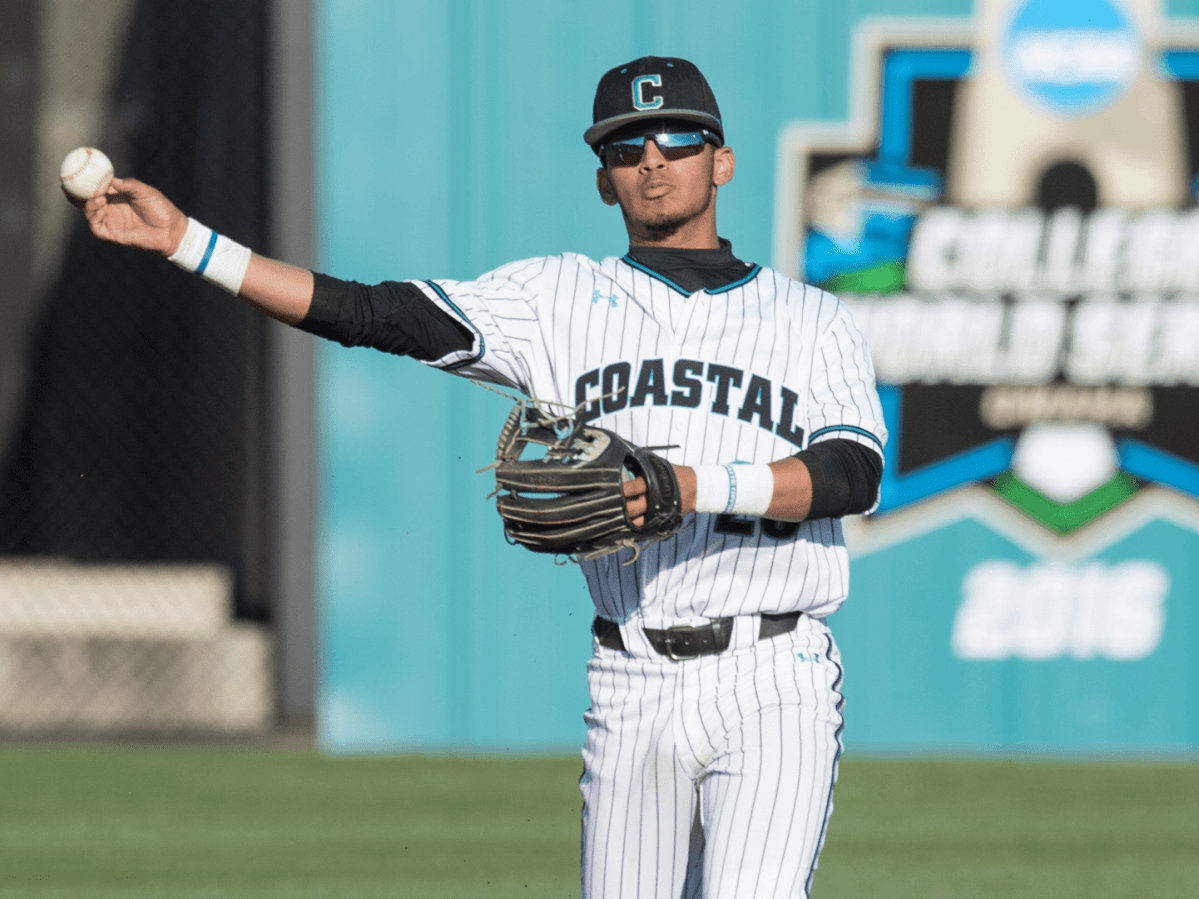
On the other side of the ball, Brown served as Coastal Carolina’s everyday shortstop this spring, though he also has prior experience at second base and third base. The 5-foot-10, 190-pound infielder saw time at all three positions while playing for the Cotuit Kettleers of the Cape Cod Baseball League last summer.

Per his Baseball America scouting report, Brown is “an unusual hitting prospect given his unique setup. Brown starts with his hands fully extended from his body and raised up above his head — which leads to Craig Counsell comparisons — before slowly drawing them back in his load, with a long and deliberate leg kick in the lower half. It is far from a picturesque swing and scouts typically find themselves put off initially, but it’s hard to argue with the numbers he’s posted as a college shortstop.

“Brown has always shown impressive plate discipline and he has solid exit velocity numbers as well, giving him a chance for more power if he can get the ball in the air more frequently,” it continues. “He’s an impressive athlete and solid defender who has a chance to stick at shortstop.”

A native of Louisiana, Brown told The Post and Courier’s Danny Kelly back in March that he models his fielding after former Red Sox shortstop Jose Iglesias and his swing after former Red Sox outfielder Mookie Betts, as well as current Mariners outfielder Mitch Haniger.

Brown, who turns 22 in December, participated in the MLB Draft Combine in San Diego last month. If he took part in MLB’s pre-draft MRI program, he would have to receive a signing bonus offer of at least 75% of his slot value.

So, if the Red Sox were to select Brown with the 24th overall pick — which has a recommended slot value of roughly $2.975 million — on July 17, they would have to offer him a signing bonus of no less than $2,231,175. Otherwise, he would become a free-agent.

It has been a while since Boston took a college infielder in the first round of a draft, as you would have to go back to 2012 when Arizona State University shortstop Deven Marrero was also taken with the 24th overall selection.

Coastal Carolina is a school the Sox rarely draft out of, but Brown could nevertheless prove to be a difference-maker if he falls to Boston in the early stages of this year’s draft in Los Angeles. The pandemonium will begin in just over a week.

(Picture of Eric Brown courtesy of Coastal Carolina Athletics)

Latest Baseball America mock draft has Red Sox selecting Arkansas’ Cayden Wallace with second-round pick

In his latest 2022 mock draft for Baseball America, Carlos Collazo has the Red Sox taking University of Arkansas infielder Cayden Wallace with their second-round pick at No. 41 overall.

The Red Sox were awarded with the 41st overall pick in this year’s draft after failing to sign University of Florida outfielder Jud Fabian last summer. It comes with an attached slot value of $1,905,500, which accounts for roughly 24% of Boston’s bonus pool.

As for the player himself, Wallace is currently regarded by Baseball America as the 54th-ranked prospect in this year’s draft class. The 20-year-old hits from the right side of the plate and just put the finishing touches on a sophomore season in which be batted .298/.387/.553 with 20 doubles, one triple, 16 home runs, 60 RBIs, 62 runs scored, 12 stolen bases, 38 walks and 56 strikeouts over 67 games (323 plate appearances) for the Razorbacks.

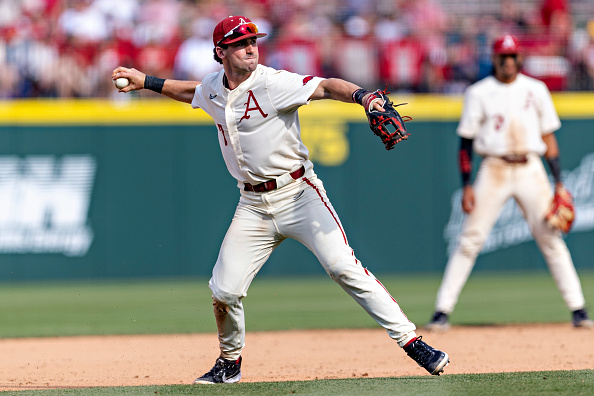
Listed at 6-foot-1 and 205 pounds, Wallace exclusively played third base this season. The Greenbrier, Ark. native does have past experience elsewhere, however, as he played left and right field as a freshman and for the Bourne Braves of the Cape Cod Baseball League last summer.

Per his Baseball America scouting report, Wallace “has one of the best infield arms in college baseball. He doesn’t need to set his feet to get something on his throws, which makes him a wiz at charging into bare-hand bunts. When he does set his feet, his throws seem rocket powered. He is comfortable leaving his feet, knowing he has the arm to pop up and make the play. In addition to having a plus-plus arm and above-average defense at third, Wallace is a heady baserunner” with average speed.

“Wallace has above-average bat speed and has shown he can catch up to velocity. He has an average bat with average power,” it continues. ” He likes to drop the bat head to pull the ball, but he also has shown he can drive the ball to right-center. He can be busted up and in on his hands.”

Wallace, who turns 21 in August, participated in last month’s MLB Draft Combine in San Diego If he consented to MLB’s pre-draft MRI program, he would have to receive a signing bonus offer of at least 75% of his slot value.

To put it another way, the Red Sox would have to offer Wallace at least $1,429,125 in signing bonus money if they were to take him in the second round as Baseball America forecasts. If they do not, Wallace would then become a free agent.

That being said, Arkansas is a school the Red Sox have liked drafting out of in recent years. Since 2014, Boston has selected five former Razorbacks in the amateur draft, including 2015 first-rounder Andrew Benintendi.

It remains to be seen if Wallace will make it to the second round of this year’s draft or will instead be taken in the first round like Benintendi. On that note, though, the 2022 MLB Draft will get underway in Los Angeles on July 17.

(Picture of Cayden Wallace: Wesley Hitt/Getty Images)

Latest ESPN mock draft has Red Sox taking LSU’s Cade Doughty with second-round pick

In his latest 2022 mock draft for ESPN.com, Kiley McDaniel has the Red Sox taking Louisiana State University infielder Cade Doughty with their second-round pick at No. 41 overall.

The Red Sox received the 41st overall pick in this year’s draft after failing to sign 2021 second-round pick Jud Fabian out of the University of Florida.

Another SEC product, Doughty is currently regarded by Baseball America as the 56th-ranked prospect in this summer’s draft class. The 21-year-old Denham Springs native was originally selected by the Detroit Tigers in the 39th round of the 2019 amateur draft out of high school, but he opted to honor his commitment to LSU as opposed to going pro then.

In 59 games with the Bayou Bengals this season, the right-handed hitting Doughty batted .298/.393/.567 with 19 doubles, 15 home runs, 57 RBIs, 56 runs scored, four stolen bases, 29 walks, and 49 strikeouts over 282 plate appearances. He missed nearly two weeks of action from late May until early June due to a dislocated left shoulder.

Per his Baseball America scouting report, Doughty “doesn’t possess the lightning-quick bat speed seen in other high-round prospects, but more times than not, his timing is right, and his barrel stays in the zone with slight lift and proper extension. He has expanded the zone a bit more in 2022, as the punchouts increased from a year ago, with 49 in 238 at-bats. Seeing a heavy dose of plus sliders with high-velocity fastballs that the SEC has to offer, Doughty has proven in his time at Baton Rouge he can perform against the country’s top arms. When his plate discipline is on point, he is in the discussion of the upper-tier bats in this year’s class.”

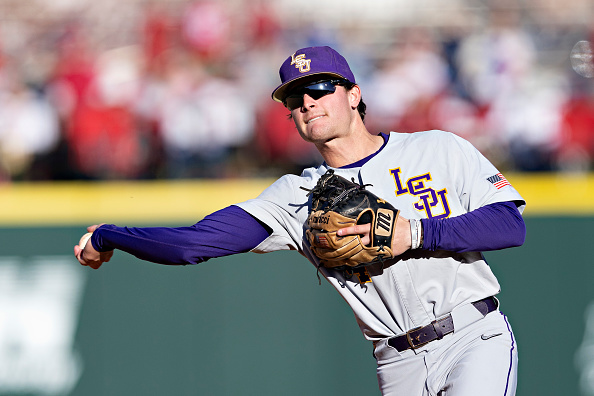
Defensively, the 6-foot-2, 195-pounder saw the majority of his playing time this year come at second base while making a handful of appearances at third base and shortstop as well. Baseball America notes that “his range isn’t quite there for shortstop, but his solid-average arm is more than capable to handle third. There is room for improvement on the dirt but his athleticism and baseball IQ are enough to be hopeful that Doughty will be able to stay on the infield moving forward.” 

On the basepaths, Doughty has amassed just nine stolen bases in his three seasons at LSU. In regards to his speed, the redshirt sophomore is best described as an average runner who “will capitalize on defensive mishaps as he has throughout his career” in Baton Rouge.

Doughty, who does not turn 22 until next March, was one of 255 prospects who participated in the MLB Draft Combine in San Diego earlier this month. It is unclear if he consented to the pre-draft MRI program, which would require whichever team that drafts him to offer no less than 75% of the recommended slot value in the form of a signing bonus.

The 41st pick in this summer’s draft, for instance, has a recommended slot value of $1,905,500. So, if the Red Sox were to select Doughty in the second round, they would have to offer him at least $1,429,125 in signing bonus money or would otherwise risk losing him to free agency.

Boston has not drafted and successfully signed a player out of LSU since 2011, when it took right-handed reliever Matty Ott in the 13th round.

(Picture of Cade Doughty: Wesley Hitt/Getty Images)

Latest MLB Pipeline mock draft links Red Sox to University of Florida outfielder Sterlin Thompson

In his latest 2022 mock draft for MLB Pipeline, MLB.com’s Jim Callis writes that the Red Sox will more than likely “wind up with a college outfielder” with the 24th overall pick in the first round.

While Callis links University of Tennessee teammates Jordan Beck and Drew Gilbert to the Sox, he also suggests that the club “could have interest in” University of Florida outfielder Sterlin Thompson.

Thompson, who turns 21 on Sunday, is currently regarded by MLB Pipeline as the 27th-ranked prospect in this year’s draft class. With the Gators this season, the left-handed hitting sophomore batted .354/.443/.563 with 16 doubles, two triples, 11 home runs, 51 RBIs, 59 runs scored, 10 stolen bases, 37 walks, and 47 strikeouts over 66 games and 305 plate appearances.

On the other side of the ball, Thompson logged 44 games in right field this year. The 6-foot-4, 200 pounder also appeared in 26 contests as a second baseman for the first time in his collegiate career.

Per his MLB Pipeline scouting report, Thompson “has long shown a good feel to hit from the left side of the plate with a very good approach. He can use the whole field and drive the ball to the gaps, rarely missing a fastball, though he struggles a bit more with softer stuff.”

Defensively, it noted that “most scouts feel an outfield corner is his best long-term home at the next level. Wherever he plays, it’s his left-handed bat that will carry him and potentially get him drafted in the top three rounds.”

The Red Sox have an extensive history when it comes to drafting players out of Gainesville. Last year alone, they took fellow outfielder and Ocala, Fla. native Jud Fabian in the second round and catcher Nathan Hickey in the fifth round. Fabian may not have signed with Boston, but Hickey has since emerged as arguably the top catching prospect in the organization.

The recommended slot value for the 24th overall pick in this year’s draft comes in at roughly $2.975 million. Because Thompson participated in the MLB Draft Combine earlier this month and presumably took part in the pre-draft MRI program, he would have to receive a signing bonus offer of at least 75% of the slot value of his pick.

So, if the Red Sox were to take someone like Thompson at No. 24, they could offer him no less than $2,231,175 in signing bonus money. According to Baseball America, if this requirement is not met, “players would become free agents and teams would not receive a supplemental pick during the following year.”

On that note, the 2022 MLB Draft gets underway in Los Angeles on July 17. So it begins three weeks from Sunday.

(Picture of Sterlin Thompson: Samuel Lewis/Icon Sportswire via Getty Images)

Should Red Sox consider taking Oregon State outfielder Jacob Melton with top pick in this year’s draft?

With the 2022 MLB Draft fast approaching, the Red Sox continue to be linked to college outfielders in recently-published mock drafts from industry experts.

MLB.com’s Jim Callis, for instance, has the Red Sox taking University of Tennessee outfielder Drew Gilbert with their top pick in his latest mock that was released on Wednesday night.

Last week, Baseball America’s Carlos Collazo had Boston selecting University of California, Berkeley outfielder Dylan Beavers with the 24th overall pick.

Needless to say, there seems to be some speculation within the industry that chief baseball officer Chaim Bloom and Co. could be leaning towards taking a college bat when the Red Sox are first on the clock on July 17.

Taking that into consideration, Oregon State outfielder Jacob Melton should probably be viewed as a potential Red Sox target as well. In fact, Collazo wrote that the Oregon native “is being scouted throughout the back of the first round.”

Melton, 21, is currently regarded by Baseball America and MLB Pipeline as the 25th- and 54th-ranked prospect in this year’s draft class, respectively.

In 60 games with the Beavers (who are currently in the super regionals of the College World Series) this season, the left-handed hitting junior batted a stout .360/.422/.668 with 21 doubles, four triples, 16 home runs, 81 RBIs, 65 runs scored, 21 stolen bases, 24 walks, and 47 strikeouts over 282 plate appearances en route to being named the Pac-12 Conference’s Player of the Year.

Per his Baseball America scouting report, Melton’s “production is prettier than his swing, which is described as ‘unorthodox’ and features plenty of moving parts. He starts with an open stance and features a leg kick in his load, with a long load that includes a barrel dump on the back half and an arm bar. Despite those mechanics, Melton has plenty of bat speed and the athleticism to make it work. While his bat path might not be ideal, his barrel stays in the zone for a long time and he has the strength to drive the ball with authority, with a frame that suggests more could be coming.”

MLB Pipeline, on the other hand, notes that the 6-foot-3, 208 pounder “has the chance to do some damage from the left side of the plate. He has an advanced approach at the plate and makes a ton of contact. He also has a good amount of juice to his pull side, and he’s tapped into that power even more in 2022, leading some scouts to think he might have better than average pop in the future.”

Defensively, Melton has moved from first base to the outfield over the course of his collegiate career and has now established himself as Oregon State’s everyday center fielder. Baseball America labels his arm strength as average while MLB Pipeline indicates that he is capable of playing all three outfield positions given his plus speed, which also helps him on the basepaths.

Melton, who turns 22 in September, is projected to go to the Giants at No. 30 by Collazo and to the Astros at No. 28 by Callis. The recommended slot value for both of this picks ($2.485 million and 2.62 million, respectively) is a bit lower than the $2,974,900 attached to the Red Sox’ first-round selection.

Because of this difference, the Sox could look to cut an underslot deal with Melton if they were to take him at No. 24, though that remains to be seen for a number of reasons.

Boston last used a first-rounder on an Oregon State player in 2005, when speedy outfielder Jacoby Jacoby Ellsbury was selected with the 23rd overall pick. Unlike Ellsbury at that time, though, Melton has never been drafted before.

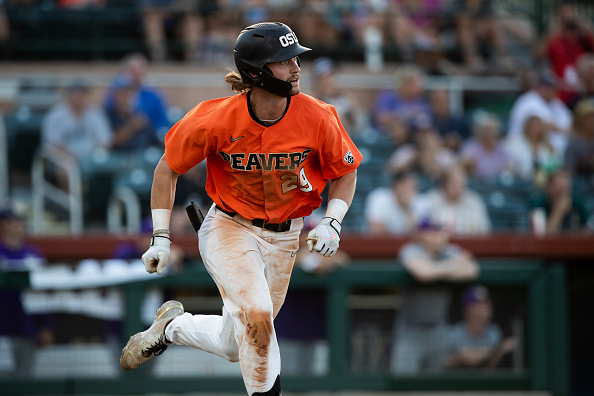
(Picture of Jacob Melton: Zac BonDurant/Icon Sportswire via Getty Images)

Latest mock draft has Red Sox selecting Vanderbilt commit Ryan Clifford with second-round pick

When the Red Sox failed to sign University of Florida outfielder Jud Fabian in the wake of last summer’s amateur draft, they were rewarded with the 41st overall pick in this year’s draft.

The 41st pick will be made shortly after the Dodgers kick off the second round and Day 2 of the 2022 MLB Draft in Los Angeles on July 18. The selection has a recommended slot value of $1,905,500, which accounts for approximately 23.6% of Boston’s $8,078,300 bonus pool.

With that, chief baseball officer Chaim Bloom and Co. could go a number of different directions when it comes to the Sox’ second-round pick. They could target a college outfielder as they did last year or perhaps even a high schooler.

In his latest mock draft for Prospects Live, Joe Doyle has the Red Sox taking Pro5 Baseball Academy outfielder Ryan Clifford with their second-round selection at No. 41 overall.

Clifford, who turns 19 next month, is currently regarded by MLB Pipeline as the No. 68 prospect in this year’s draft class. Baseball America lists the North Carolina native as its 77th-ranked draft-eligible prospect.

Listed at 6-foot-3 and 206 pounds, Clifford is committed to play college baseball at Vanderbilt University. The left-handed hitting, left-handed throwing outfielder has long been in the spotlight while playing for USA Baseball at several different levels.

Per his MLB Pipeline scouting report, Clifford “is equipped to hit for average and power” on account of his “picturesque” left-handed swing. “He has an advanced approach at the plate, focusing on driving balls from gap to gap while rarely chasing pitches out of the strike zone. With his bat speed and the strength in his 6-foot-3 frame, he could provide 25-30 homers per year once he starts driving the ball in the air more regularly. ”

Baseball America, on the other hand, notes that Clifford “developed a strong reputation as a hitter by playing up throughout his travel ball career and developing a solid track record with power potential in a strong, 6-foot-3, 206-pound frame. He’ll need to hit, as he has an offensive-forward corner profile and limited supplemental tools.”

On the other side of the ball, Clifford can best be described as a below-average runner with fringy speed who is “committed to working on his quickness and defense.” In addition to the outfield, the 18-year-old has experience at first base and could either settle there or in a corner outfield position in the long-run.

Because of these traits, Clifford has drawn comparisons to Diamondbacks first baseman Seth Beer, who was originally selected by the Astros in the first round of the 2018 amateur draft. The Red Sox had a chance to draft Beer, but instead took another first baseman in Triston Casas two picks prior.

(Picture of Ryan Clifford via his Instagram)

Latest mock draft links Red Sox to James Madison University outfielder Chase DeLauter

In his latest 2022 mock draft for Prospects Live, Joe Doyle has the Red Sox selecting University of Tennessee outfielder Jordan Beck with their top pick at No. 24 overall.

That is nothing new, as Beck has been connected to the Sox in past mock drafts. What does stick out here, though, is that Doyle links Boston to California’s Dylan Beavers and James Madison University outfielder Chase DeLauter.

“Dylan Beavers and Chase DeLauter are worth monitoring here,” writes Doyle, “the latter being one of the best players left on the board and a guy the Red Sox got a ton of lengthy looks at while on the Cape in 2021.”

DeLauter, 20, is currently regarded by Baseball America as the No. 18 prospect and by MLB Pipeline as the No. 19 prospect in this year’s draft class.

Playing for the Orleans Firebirds of the Cape Cod Baseball League last summer, DeLauter opened some eyes by slashing .298/.397/.589 to go along with a league-leading nine home runs and 21 RBIs in 34 games.

With the Dukes this season, the left-handed hitting junior batted .437/.576/.828 with eight doubles, one triple, eight homers, 35 RBIs, 31 runs scored, 10 stolen bases, 28 walks, and 21 strikeouts over 24 games spanning 118 plate appearances. His season ended in early April when he sustained a broken left foot after sliding into second base on a double.

Per his Baseball America scouting report, the West Virginia native “has plenty of strength … that gives him plus raw power and while his swing isn’t described as fluid, he gets himself into good hitting position consistently. He’s uniquely athletic for his size and has posted double-plus run times in the 60-yard dash.”

MLB Pipeline, on the other hand, notes that DeLauter “could be a middle-of-the-order type of hitter. He’s put up gaudy numbers at JMU, beating up the pitching in the mid-major Colonial Athletic Conference. He has at least plus raw power and even though there’s a little drift to his lower half that causes him to be more of a front-foot hitter at times, he’s so big and strong he can still out-leverage pitching.”

Defensively, DeLauter possesses the kind of speed that has allowed him to stay in center field to this point, though most evaluators view the 6-foot-4, 235 pounder as a future corner outfielder given his size and power profile. His arm strength is to be reckoned with as well on account of his past experience as a pitcher.

If DeLauter, who turns 21 in October, were to fall to the Red Sox at No. 24 on July 17, he would become the first college outfielder the club used a first-round pick on since Andrew Benintendi, whom they took out of the University of Arkansas in 2015.

The recommended slot value for the 24th overall pick in this year’s draft, which will take place in Los Angeles, comes in at roughly $2.975 million.

Besides Beavers, Beck, and DeLauter, other college outfielders who have been linked to the Red Sox include Tennessee’s Drew Gilbert and Stanford’s Brock Jones.

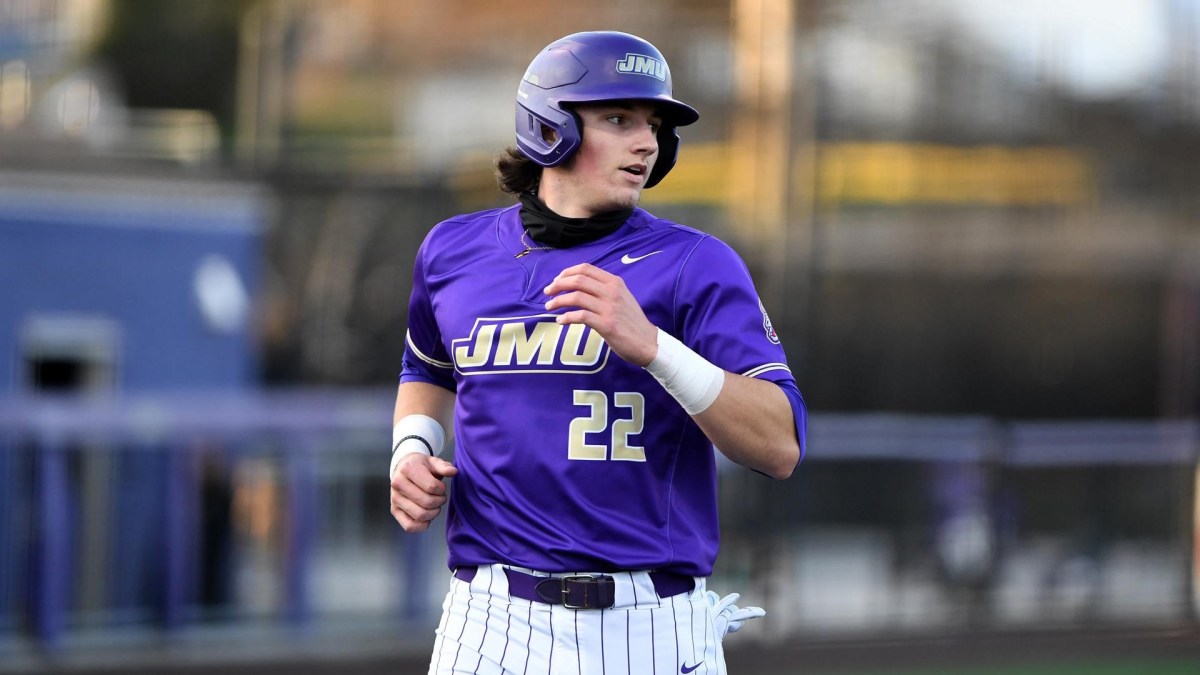
(Picture of Chase DeLauter: James Madison University Athletics)