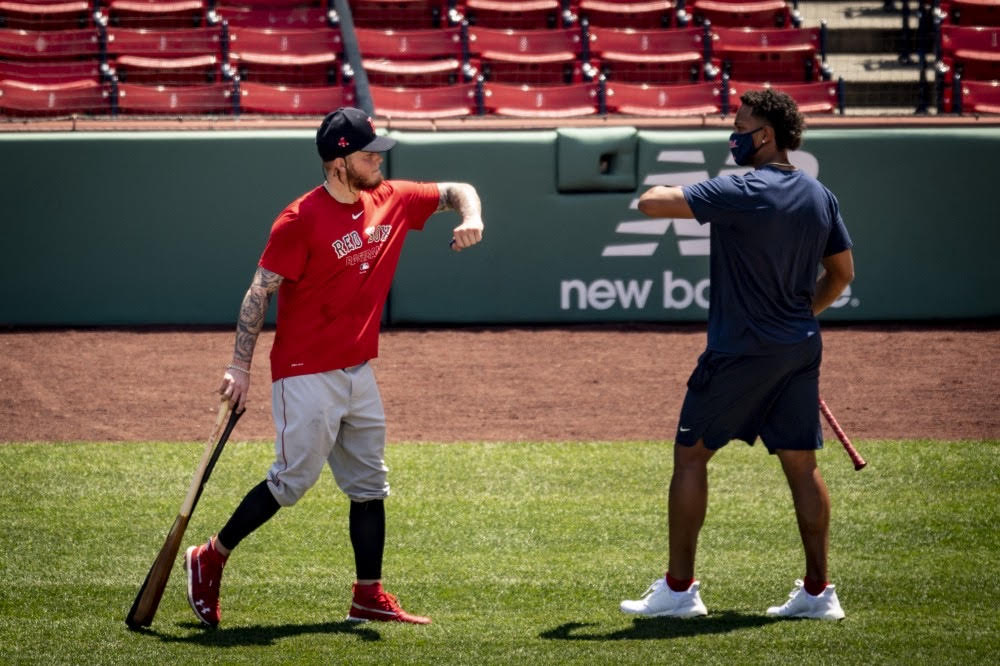
Since Summer Camp workouts began at Fenway Park last Friday, Red Sox players have used the ballpark’s luxury suites as locker rooms in order to practice social distancing.
Whenever a player isn’t doing something on the field or in the concourse, you will typically find him in his suite, eating a pre-packaged meal or simply hanging out.
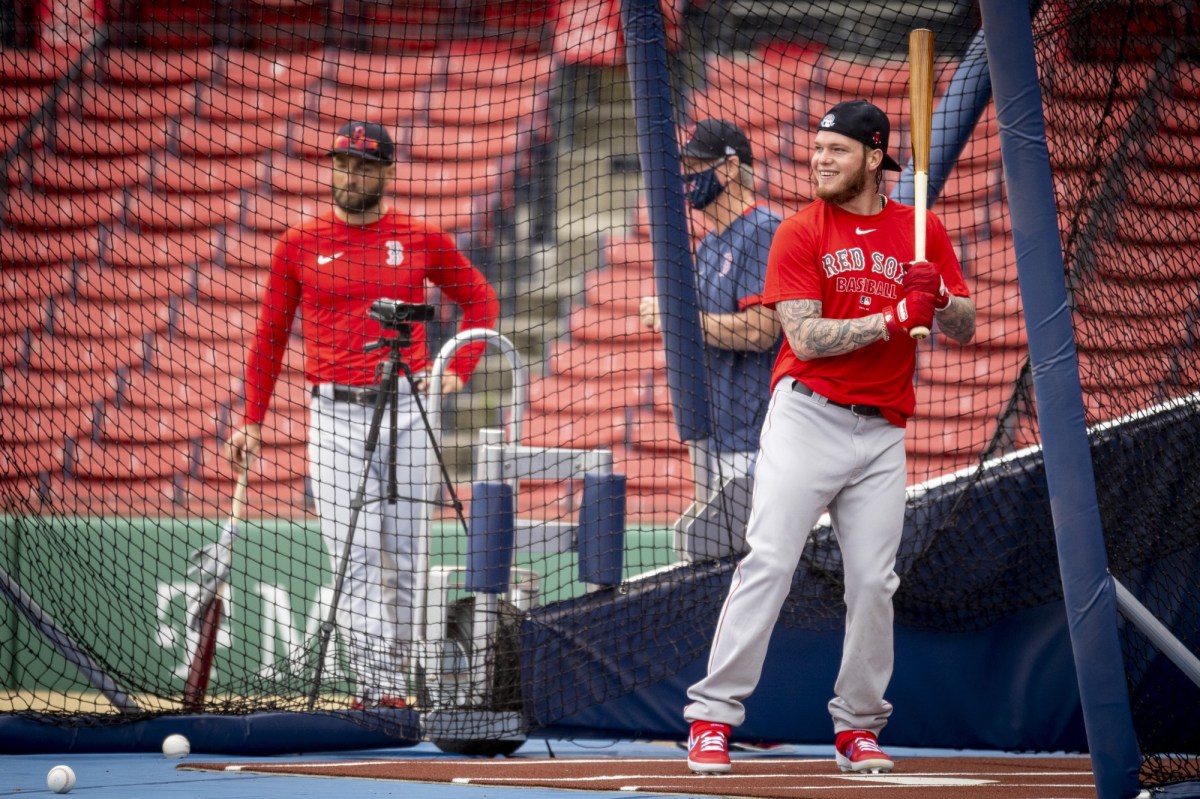
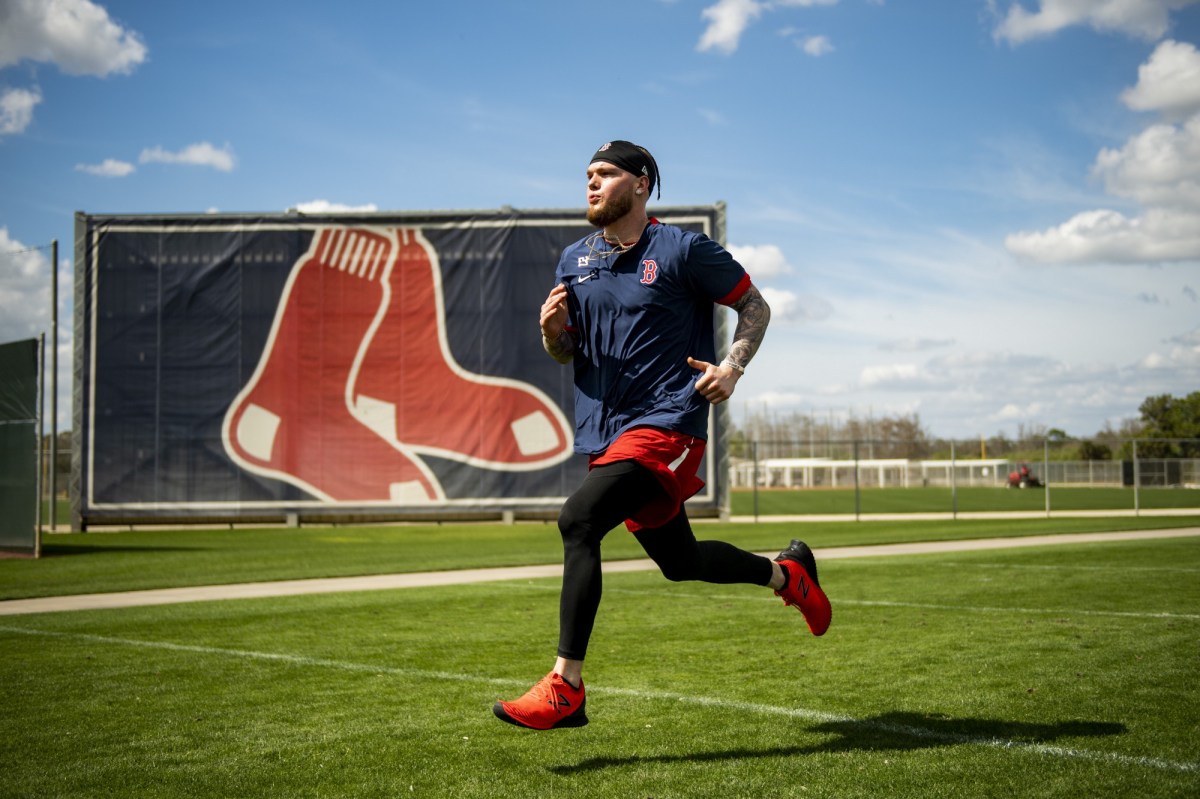
Red Sox shortstop Xander Bogaerts was in that scenario on Monday, and while taking in the view of Fenway from his luxury box, he also had the chance to watch new teammate Alex Verdugo take batting practice. That is something he did not have the opportunity to do in Fort Myers during the initial version of spring training because Verdugo was working his way back from a stress fracture in his lower back.
Now, after watching a healthy Verdugo in his element at the plate, Bogaerts is impressed with what he saw.
“I saw him take BP yesterday,” the two-time All-Star told reporters via Zoom on Tuesday. “He was hitting that ball pretty good, to be honest. I was watching him from the top of my suite. He came here and he was hurt and he was getting treatments so I didn’t see a lot of him while he was with us (in spring training). Obviously only with the Dodgers. But he seemed pretty good and obviously that’s going to be a guy that we lean heavy on. And he’s healthy. So the more guys that are healthy, the better.”
The centerpiece of the Mookie Betts trade with the Dodgers from February, Verdugo is hoping to see regular playing time for Boston despite being part of a crowded outfield picture that includes Andrew Benintendi, Jackie Bradley Jr., Kevin Pillar, and J.D. Martinez, to an extent.
“I want to play and I want to be a starter,” the 24-year-old said Saturday. “That’s what everybody comes into the big leagues for. That’s what everybody wants to be. So I want to play every day. But, if they want to do what they have to do, then I’ll follow and I’ll play as hard as I can.”
A left-handed hitter by trade who made his major-league debut in September 2017, Verdugo owns a career .273/.335/.448 slash line in 355 plate appearances against right-handed pitchers, and a career .306/.333/.452 slash line in 133 plate appearances against left-handed pitchers. He will be the first Red Sox player to ever don the No. 99 on his uniform.
For the first time since last September, Red Sox outfielder Alex Verdugo faced live hitting on Saturday.
Throughout spring training and the COVID-19 pandemic-induced layoff, the 24-year-old was limited to hitting at home and in the batting cages at JetBlue Park while working his way back from a lower back stress fracture.
As excited as he was to get back to seeing live pitching at Fenway Park on Saturday, facing off against flame-throwing right-hander Nathan Eovaldi was no easy task.
“Let’s say I got welcomed real quick to good old 99 MPH,” Verdugo told reporters via Zoom. “The biggest thing for me today was to see the (velocity) out of his hand, see one of the most elite, best pitchers and go from there. I took a full swing, swung and missed and had no pain or discomfort. That was reassuring. That’s what this is about, to get my timing back, to reassure that my body, physically, is handling progression really well.”
The COVID-19 break has physically “done wonders” for Verdugo’s body in terms of endurance and strength. He is now looking forward to making a name for himself in a crowded Red Sox outfield.
“For me, I’m an everyday player,” the left-handed hitter said when asked about the prospect of being part of a platoon. “That’s just that. It’s that simple. There’s no ifs, ands or buts about it. I want to be out there every single day competing. It doesn’t matter if it’s a lefty out on the mound to a righty on the mound. I feel like my splits are reversed. I hit lefties better than I hit righties. So I’m just someone who wants to be out there every single day. I want to play and I want to be a starter.”
Speaking of splits, since making his major-league debut with Los Angeles in 2017, Verdugo owns a career .273/.335/.448 slash line in 355 plate appearances against right-handed pitchers, and a career .306/.333/.452 slash line in 133 plate appearances against left-handed pitchers. So, he’s not entirely wrong about having reverse splits.
As currently constructed, the Red Sox have three left-handed hitting outfielders on their active roster in Verdugo, Andrew Benintendi, and Jackie Bradley Jr. Kevin Pillar and J.D. Martinez represent the opposite side of that coin as two right-handed hitting outfielders.
Despite how amped up he may be to get back on the field, it would not be shocking to see the Sox ease Verdugo back into things, especially when considering how serious back injuries can be.
How Roenicke manages the outfield once the 2020 campaign begins will definitely be something to keep an eye on.
In terms of preparations for the upcoming, abbreviated 2020 season, Red Sox outfielder Alex Verdugo is “probably further along than anyone,” manager Ron Roenicke told reporters earlier Monday afternoon.
That being the case because, according to Roenicke, the 24-year-old “has been on the field and hitting in the cage” under team supervision while other players have not gotten that opportunity.
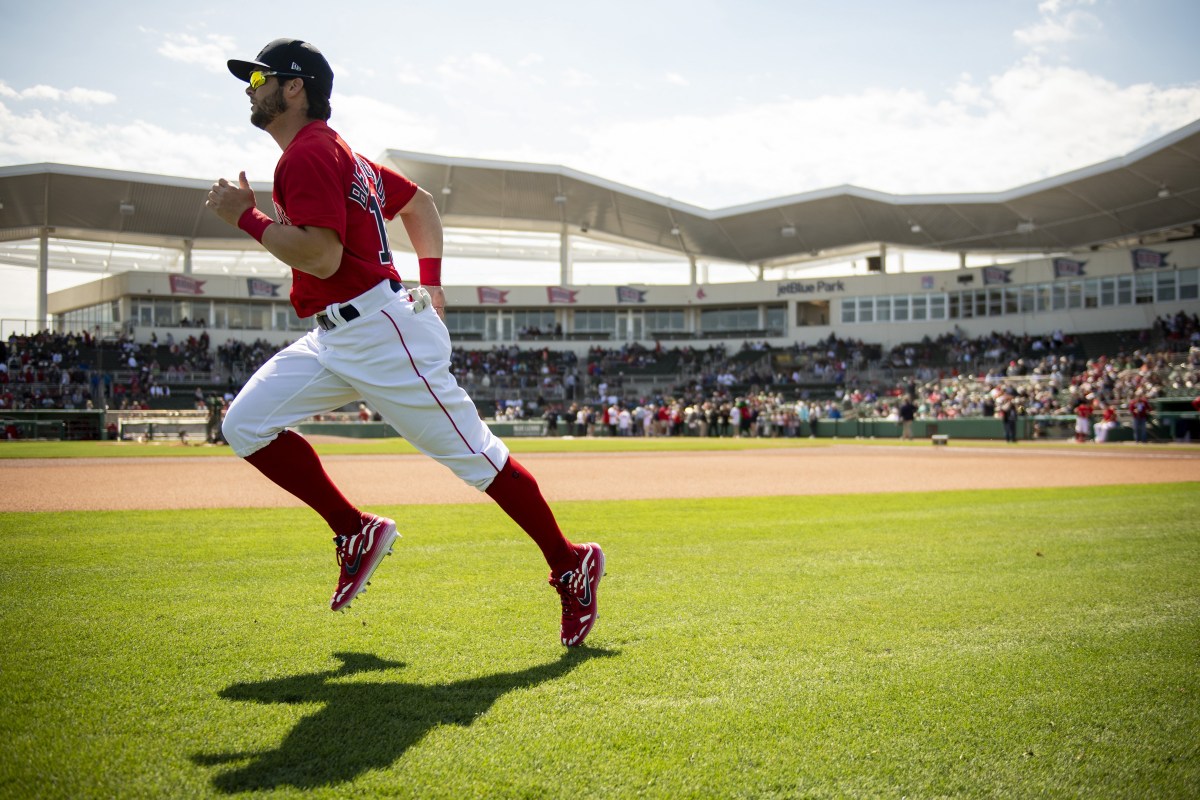
Coming off a stress fracture in his lower back suffered while with the Dodgers last season, Verdugo, along with left-hander Chris Sale, had the opportunity to report back to JetBlue Park earlier than most players last month in order to continue his rehab.
Because of this, in addition to the fact that he remained in Florida during the COVID-19 pandemic-induced shutdown, the Arizona native was able to get some work in at the Fenway South complex in Fort Myers.
Prior to said shutdown ordered by Major League Baseball back in March, it looked as though Verdugo would miss the first chunk of the original 2020 season due to that stress fracture.
Now, as chief baseball officer Chaim Bloom told reporters last week, the former Dodgers top prospect “should be all systems go” once the Red Sox report to Fenway Park for summer training camp on Wednesday.
As things stand at the moment, it looks like Verdugo could split time in right field with Kevin Pillar as he eases his way back from that back ailment.
Roenicke also mentioned that things “could change [for Verdugo] depending on how things match up with opposing teams.”
Since making his major-league debut with Los Angeles in 2017, the former second-round draft pick owns a career .273/.335/.448 slash line in 355 plate appearances against right-handed pitchers, and a career .306/.333/.452 slash line in 133 plate appearances against left-handed pitchers.
The day-to-day status of Verdugo will certainly be something to monitor once training camp begins this week. As Roenicke put it, hopefuly there won’t be any setbacks and he’ll be ready to go once Opening Day 2.0 rolls around in late July.
In his most recent Big Board for The Athletic, former Reds and Nationals general manager Jim Bowden ranked Red Sox outfielder Andrew Benintendi as the ninth-best left fielder in baseball.
Listed behind Washington’s Juan Soto, Houston’s Michael Brantley, Tampa Bay’s Austin Meadows, San Diego’s Tommy Pham, Atlanta’s Marcell Ozuna, Chicago’s Eloy Jimenez, Pittsburgh’s Bryan Reynolds, and Oakland’s Mark Canha, Benintendi, per Bowden, “is the most disappointing left fielder in baseball.”
Leading with that is certainly an interesting way to make your case that Benintendi is one of the best left fielders in the game, but Bowden defends his ranking by saying “Now you’re probably wondering how [Benintendi] made this list. It’s simple. I’m betting on him and the fact that he’s only 25 years old and is primed for a breakout season.”
As we know, Benintendi, a former first-round pick out of Arkansas in 2015, had a very underwhelming 2019 campaign in what was initially supposed to be a breakout year.
One of the reasons for Benintendi’s struggles, as Bowden notes, is that he bulked up a bit in the months following the 2018 World Series, which the Red Sox believe may have actually slowed down his swing and mechanics, resulting in an all-around down year in terms of offensive production.
Now though, after slimming back down and getting the chance to work with hitting coach Tim Hyers and assistant hitting coach Peter Fatse during the offseason, the club believes that “they’ve been able to get [Benintendi] mechanically back to where he was in 2017 when he hit 20 homers, stole 20 bases and was on base over 35 percent of the time” en route to finishing second in American League Rookie of the Year voting.
After dealing with some adversity and tough injury luck in 2019, Benintendi inked a two-year, $10 million contract extension with Boston in February that essentially buys out his first two seasons of arbitration eligibility.
If baseball is played in 2020, the 25-year-old Cincinnati native will be counted on to be a surefire presence at the top of the Red Sox lineup. Even more so now that Mookie Betts is a Dodger.
I’ve said it before and I’ll say it again: I’m a big Andrew Benintendi guy. Have been for quite awhile. But, from what I’ve seen online, he definitely has plenty of doubters, and what better way to silence those doubters than to put together your best season in the majors in 2020?
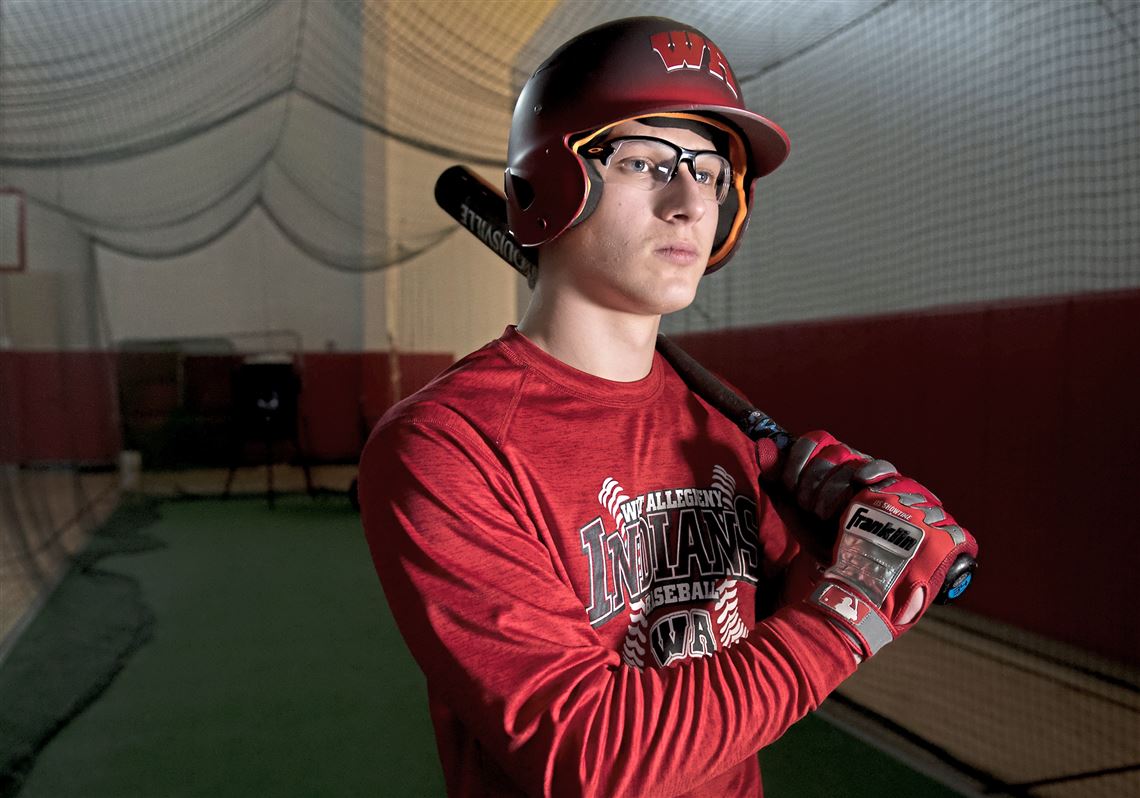
In his latest mock draft for the Baseball Prospect Journal, Dan Zielinski III has the Red Sox taking West Allegheny High School outfielder Austin Hendrick with their top pick at No. 17 overall.
Hendrick, who turns 19 four days after the 2020 draft is completed, is ranked by MLB Pipeline as the No. 2 prep outfielder in this year’s class behind only Zac Veen.
The Pennsylvania native’s Baseball America’s scouting report goes as follows:
Is there a high school hitter in the 2020 class with a better hit and power combination than Hendrick? We don’t think so. The Pennsylvania product is likely a corner outfielder, but he has light tower raw power and some of the quickest bat speed scouts have seen in years.
Playing for Team USA in last summer’s U-18 Baseball World Cup in South Korea, the Mississippi State signee didn’t get the chance to display that power, but he did get on base quite a bit by drawing five walks and getting plunked twice over the span of eight games.
Among all the high school prospects who will make up this year’s draft class, the left-handed hitting Hendrick has the best raw power tool of the lot, according to FanGraphs. That likely makes him a very appealing target for clubs whose first-round pick fall within the top 20.
The Red Sox, under chief baseball officer Chaim Bloom and amateur scouting director Paul Toboni, own the 17th overall pick in the 2020 first-year player draft, as previously mentioned.
With that, Boston will have up to $3,609,700 in signing bonus money to spend on their first of just four selections in this year’s draft, which will go down as the shortest in the sport’s history.
Because of how limited they will be in the 2020 draft, it would not be surprising to see the Red Sox try and make a splash with their top pick. And what better way to do that than by taking one of the best high school outfielders in this year’s class? If he is still on the board, that is.
Other outfielders who have been linked to the Red Sox in first-round mock drafts include UCLA’s Garrett Mitchell, Arkansas’ Heston Kjerstad, Independence High School’s Robert Hassell, and Harvard-Westlake’s Pete Crow Armstrong.
The 2020 MLB Draft, which will consist of five rounds, is just over two weeks away. Stay tuned for more coverage.
The start date and length of the 2020 MLB first-year player draft may both be unknowns at this point in time, but that’s not stopping clubs from doing their due diligence ahead of the annual amateur selection process.
After not having any first-round picks last year due to luxury tax-related penalties from 2018, the Red Sox are slated to make their first selection with the 17th overall pick in this year’s draft. That being the case because at 84-78, Boston finished with the 17th-worst record in baseball last season.
According to Baseball America, the 17th overall pick in the 2020 draft has an assigned slot value of approximately $3,609,700, meaning that’s how much money the Sox will have to spend on that pick, although they can go over that allotted amount if they are willing to incur some tax penalties.
Personally, I’m no draft expert, but since the 2020 MLB Draft is right around the corner, I thought it would be a good idea to look into who Red Sox chief baseball officer Chaim Bloom and Co. could be targeting in the earliest stage of this year’s draft. Let’s get into it.
Target No.1: RHP Nick Bitsko, Central Bucks High School East (Doylestown, PA)
In his mock draft from April 15th, CBS Sports’ Mike Axisa had the Red Sox taking high school right-hander Nick Bitsko out of Doyleston, Pa.
Bitsko, 17, was initially set to graduate from Central Bucks High School East in 2021, but he will instead graduate early, adding on to an already impressive list of draft-eligible pitching prospects this year.
A University of Virginia commit, Bitsko posted a 1.18 ERA over six starts during his sophomore season last year, per MaxPreps.
According to a Baseball America scouting report from 2019, “Bitsko has a great pitcher’s frame, standing at 6-foot-4, 220-pounds and has a smooth and easy operation on the bump, with an overhead windup and clean three-quarter slot.”
From that same scouting report, Bitsko’s arsenal includes a 92-96 MPH fastball, a 76-83 MPH curveball, and an 86-87 MPH “firm” changeup.
If drafted by the Red Sox over the summer, Bitsko would presumably become one of the top right-handed pitching prospects in the organization, although there certainly are some minor concerns given just how young he is and how he didn’t get the chance to really throw in front of scouts this year.
Target No. 2: C Patrick Bailey, North Carolina State University
Moving to the college ranks now, Dan Zielinski III of the Baseball Prospect Journal has the Red Sox taking North Carolina State backstop Patrick Bailey in his latest first-round mock draft.
The 20-year-old out of Greensboro was drafted by the Twins in the 37th round of the 2017 draft, but he opted to honor his commitment to North Carolina State instead, and it looks like that decision is going to pay off for him.
Although he played in just 17 games for the Wolfpack this year due to the college baseball season being shut down last month, Bailey produced over the course of that small sample size, as he slashed .296/.466/.685 with six home runs and 20 RBI.
Per a March scouting report from Perfect Game USA, Bailey “has significant value as a switch-hitting catcher with pop on both sides of the plate to go along with strong defensive skills.”
If taken by the Red Sox this summer, I would guess that Bailey would slide behind Connor Wong as the second-best catching prospect in Boston’s farm system.
Target No. 3: RHP Tanner Burns, Auburn University
The first college hurler on this list, My MLB Draft’s most recent 2020 mock from earlier in the month has the Red Sox taking Auburn right-hander Tanner Burns in the first round.
Another former 2017 37th-round pick, Burns was limited to just four starts and 22 1/3 innings pitched this season due to the aforementioned shutdown. In those four starts though, the 21-year dazzled by posting a 2.42 ERA and averaging nearly 13 strikeouts per nine innings.
Listed at 6’1″ and 205 lbs., MLB Pipeline has Burns ranked as their No. 28 draft prospect. They describe the junior as a hurler, who “can work at 92-97 mph with his fastball and locate it to both sides of the plate. His breaking ball can be a plus pitch at times, combining slider velocity in the low 80s with curveball depth, but it gets slurvy at others. He hasn’t had much need for his changeup, though it has some sink and shows some signs of becoming an average third pitch.”
Burns also comes with some durability concerns, as he dealt with right shoulder soreness throughout the majority of his sophomore season in 2019.
Like Bitsko, Burns would presumably become one of the top right-handed pitching prospects in the Sox’ farm system if he is drafted by Boston at some point this summer.
Target No. 4: LHP Garrett Crochet, University of Tennessee
Sticking with the Southeastern Conference here, Prospects Live has the Red Sox selecting University of Tennessee southpaw Garrett Crochet in their 2020 Mock Draft 2.0.
A native of Mississippi who turns 21 in June, Crochet was only able to make one start for the Volunteers this year due to upper back soreness. To add on to that, the left-hander broke his jaw last May after taking a line-drive to the face in his final start of the 2019 regular season that resulted in him missing two weeks of action.
According to a Prospects Live scouting report from Crochet’s lone outing of the 2020 campaign against Wright State in March, the junior’s pitch arsenal included a fastball that sat around 95-97 MPH and maxed out at 99 MPH, an 84-86 MPH slider, an 80-90 MPH changeup, and an 80 MPH curveball.
MLB Pipeline has Crochet ranked as their 18th-best draft-eligible prospect, so he could very well still be on the board by the time the Red Sox make their first pick at No. 17.
Target No. 5: OF Heston Kjerstad, University of Arkansas
Last but not least, we have the lone outfielder on this list in the University of Arkansas’ Heston Kjerstad, who Perfect Game USA’s Brian Sakowski has going to the Red Sox in the first round of his most recent 2020 mock draft from late last month.
The Amarillo, Texas native did nothing but rake in his three seasons as a Razorback, putting together a .343/.421/.590 slash line to go along with 37 home runs and 129 RBI over 150 total games dating back to 2018.
Sakowski’s scouting report for Kjerstad looks a little something like this:
“The left-handed slugger has double-plus raw pop along with the bat speed and impact generation to crush balls with wood. There are some positional questions long-term, but the Red Sox have shown the willingness to take prospects with big power and figure out how to get them into the lineup later.”
MLB Pipeline has Kjerstad ranked as their 10th-best prospect in this year’s draft, so he might not even be on the board by the time the Red Sox make their first selection at No. 17, but if he is, and the Sox take him, that would be quite the addition to an already fascinating mix of outfield prospects that includes Jarren Duran, Marcus Wilson, and Gilberto Jimenez to name a few.
—
Well, there you have it. Five prospects the Red Sox could take with the 17th overall pick in the 2020 first-year player draft. If they do wind up taking one of these five young players with their first pick, you can come back here and remember that I had it first.
Also, the 17th overall pick is the lowest first-round pick the Red Sox have had since 2016, so it’s probably important that they hit on it in order to improve a poorly-regarded, but steadily-improving farm system.
Red Sox outfielder Alex Verdugo has not been able to make as much progress in his rehab as the team was hoping for, according to interim manager Ron Roenicke, who, along with piching coach Dave Bush spoke with reporters in a Zoom call on Tuesday.
Verdugo, who is working his way back from a stress fracture in his lower back, has not been able to progress as much as the Red Sox were hoping for mainly due to the fact that the club had to shut down its facilities in Fort Myers in late March after a minor-leaguer tested positive for COVID-19.
“Unfortunately with the shutdown of the camp in JetBlue, [Verdugoo] hasn’t been able to go and continually progress probably as fast as we’d like him to,” Roenicke said Tuesday. “He is swinging and doing all the things he needs to do. Unfortunately with the shutdown there, we’re having to go basically see him. And then it makes it more difficult for him to work out.”
The Red Sox acquired the 23-year-old outfielder along with prospects Jeter Downs and Connor Wong from the Dodgers in February in the blockbuster trade that sent Mookie Betts and David Price to Los Angeles.
Upon Verdugo’s arrival to the Fenway South complex two months ago, it was revealed by Roenicke that the Arizona native did indeed have a stress fracture in his lower back.
A plan for Verdugo to work his way back from that ailment was laid out at that time, but it would appear that the league-wide, coronavirus-induced shutdown has since hindered that plan.
Still, Verdugo began taking full swings in March and Roenicke was impressed with his arm strength. The interim manager seems hopeful that if there is Major League Baseball to be played in 2020, Verdugo’s ” going to be able to fit in along with the other guys and maybe be ready for us” by the time spring training activities would resume.
In the interim, Verdugo has remained in Florida, as he believed it was the best place for him to continue with his rehabilitation. He’s posted videos of himself swinging a bat on Instagram as recently as last Thursday and may be in line for another MRI in the near future to make sure that the stress fracture is completely healed before he begins playing in games again.
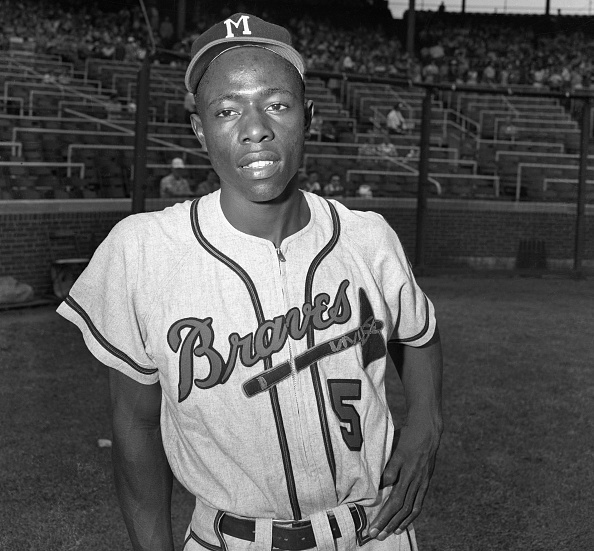
Over the course of his 23-year major-league career, Hall of Famer Hank Aaron is most notoriously known for his contributions to the game of baseball in the cities of Milwaukee, Atlanta, and Milwaukee again.
Despite being a legend in those two cities though, it’s worth mentioning that the 25-time All-Star begin his professional career with the city of Boston more than likely on his mind.
That being the case because as an 18-year-old who had just led the Indianapolis Clowns to a Negro League World Series title in 1952, Aaron had two major-league offers on the table from two northeast teams in the Boston Braves and New York Giants.
Since the Braves were offering a larger monthly salary than the Giants were, Aaron decided to sign with Boston and his contract was immediately purchased from Indianapolis in June 1952.
The Alabama native was assigned to Boston’s Class-C minor-league affiliate in Eau Claire, Wisc. shortly thereafter, where he promptly posted a .336 batting average and .493 slugging percentage to go along with nine home runs and 19 doubles over 87 games with the Bears.
As it turned out though, 1952 wound wind up being the last year the Braves called the city of Boston home.
At the major-league level, the Braves had struggled significantly since reaching the World Series in 1948. And that overall poor performance was met with dwindling attendance numbers at Braves Field.
Those two factors, along with the fact that the neighboring Red Sox had been gaining more and more popularity in the city, led club owner Lou Perini to make the decision to move the team to Milwaukee, the home of the Braves’ Triple-A affiliate at the time.
After Perini’s proposal was met with unanimous approval from the other National League owners, the Braves’ move to Milwaukee was made official on March 18th, 1953 while the club was still in spring training, much to the dismay of fans in Boston.
That April, the Braves opened the home portion of their 1953 schedule with a 3-2 walk-off win over the St. Louis Cardinals at brand-new Milwaukee County Stadium.
The newly-anointed Milwaukee Braves would go on to finish their first season in Wisconsin with a final record of 92-62, all while Aaron was still developing at the Class-A level in Jacksonville, where he mashed 22 home runs in 137 games for the Braves.
The following spring, Aaron broke camp by making his first career major-league Opening Day roster as Milwaukee’s starting left fielder.
At just 20 years old, he slashed .280/.322/.447 with 13 home runs and 69 RBI over his first 122 games in the majors and later finished fourth in National League Rookie of the Year voting. The Braves’ win total went down from the season prior, yet they led the NL in attendance for a second straight year.
Aaron would go on to have a superb career, winning his first and only MVP award and World Series trophy in 1957, winning two batting titles, three Gold Glove awards, and probably most significantly, breaking Babe Ruth’s home run record with his 715th career homer on April 8th, 1974.
Just five years after retiring from the game in 1975, Aaron was inducted into the National Baseball Hall of Fame in 1982 after receiving 406 of 421 votes in his first year on the ballot.
Looking at things from a broader perspective, Aaron is without a doubt one of the best outfielders to ever play Major League Baseball. He’s most well-known in Atlanta and Milwaukee, but he was only a few years off from embarking on a legendary career in the city of Boston.
In 12 career games at Fenway Park, Hammerin’ Hank posted a .745 OPS to go along with one home run and three RBI over 49 total plate appearances.
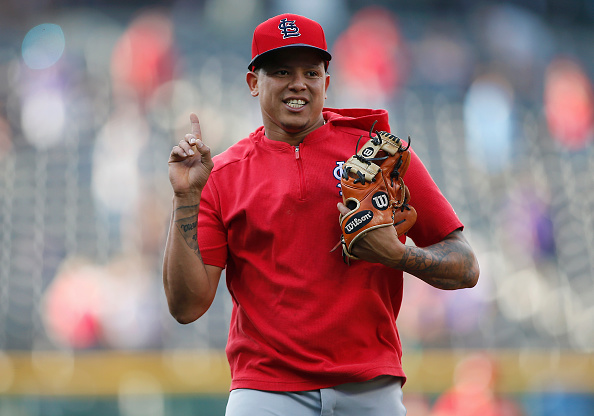
The Red Sox have signed former Cardinals utilityman Yairo Munoz to a minor-league deal, according to Major League Baseball’s official transaction wire. He was assigned to Triple-A Pawtucket on Wednesday.
Munoz, 25, was released by St. Louis earlier this month after he “left the team” and “flew home” without ever contacting the Cardinals. His agent apparently told the club that his client was frustrated with his role, something Cards manager Mike Shildt said on multiple occasions last season.
According to The Athletic’sMark Saxon, that frustration did not hamper Munoz’s chances of making the Cardinals’ Opening Day roster this year, as Shildt told him that the Dominican Republic native had an “inside track” to landing a roster spot.
That vote of confidence did not stop Munoz from receiving his unconditional release from St. Louis though, and less than three full weeks after essentially excusing himself from the Cardinals, he has joined the Red Sox on a minor-league deal for the 2020 season.
Originally signed by the Athletics as an international free agent out of the DR back in 2012, Munoz was part of the trade that sent outfielder Stephen Piscotty to Oakland in December 2017.
The former top prospect is capable of playing second base, third base, and shortstop, as well as all three outfield positions. That sort of versatility is something the Red Sox have seemed to value immensely lately.
In 88 games with the Cardinals last season, Munoz slashed .267/.298/.355 with two home runs and 13 RBI. That rather underwhelming performance for Munoz was coming off an impressive rookie campaign where he posted an OPS+ of 109 over 108 games in 2018.
Munoz still has five years of team control remaining and is not arbitration eligible until the 2021 season.
If baseball is played in 2020, Munoz could provide the Red Sox with solid infield and maybe even outfield depth at the Triple-A level.
Red Sox outfielder Andrew Benintendi is dealing with tightness in his quad, according to interim manager Ron Roenicke.
The 25-year-old has been held out of Grapefruit League action since Thursday, when he went 1-for-1 with a walk and run scored while playing the first three innings in a 12-5 loss to the Philadelphia Phillies.
It’s unclear when Benintendi initially suffered the quad tightness, but Roenicke does not seem all that concerned, as he said Sunday that, “I’m hoping when we go up to Tampa Bay to play the Yankees [on Tuesday], he’ll be ready to go. So it’s nothing bad. Just a little tight.”
Entering his fourth full season with the Red Sox, Benintendi is slashing .375/.444/.750 with one home run, one RBI, and one stolen base through four games and nine plate appearances this spring.


 Blogging the Red Sox