Red Sox first base prospect Niko Kavadas boasting top walk rate (27.5%) and fourth-best on-base percentage (.475) in Carolina League

You could say that Red Sox first base prospect Niko Kavadas is in the midst of a slump. Over his last six games with Low-A Salem dating back to April 27, Kavadas is batting just .133 (2-for-15) with one extra-base hit.

While a .133 batting average is certainly not an eye-opener, Kavadas has still managed to get on base as of late despite the lack of hits. In his last 24 trips to the plate, the left-handed hitter has drawn nine walks, which translates to a 37.5% walk rate as well as a .458 on-base percentage.

Through the first month of the 2022 minor-league season, which is also his first full professional season, Kavadas is slashing .263/.475/.474 with six doubles, two home runs, six RBIs, 10 runs scored, one stolen base, 22 walks, and 25 strikeouts over 18 games spanning 80 plate appearances with Salem.

Among qualified Carolina League hitters, the 23-year-old currently ranks second in walks, first in walk rate (27.5%), 29th in batting average, fourth in on-base percentage, 17th in slugging percentage, ninth in OPS (.949), 10th in isolated power (.211), and seventh in wRC+ (174), per FanGraphs.

Defensively, Kavadas has unsurprisingly seen all of his playing time on the field this year come at first base. The 6-foot-1, 235 pounder has logged 111 innings at the position thus far and has registered four assists while turning seven double plays.

The Red Sox originally selected Kavadas in the 11th round of last summer’s amateur draft out of the University of Notre Dame. The Indiana native officially signed with the club for $250,000 on the first day of August. Around that same time, Kavadas was identified by Baseball America as an underrated draft selection on account of his power and ability to draw walks.

While he has only hit four home runs in 33 professional games, Kavadas has already shown that he can be productive in other ways via ball four. Since being promoted from the Florida Complex League to Salem on August 25 of last year, Kavadas has drawn 30 walks while only striking out 32 times.

Kavadas, who does not turn 24 until late October, is currently regarded by FanGraphs as the No. 28 prospect and by SoxProspects.com as the No. 48 prospect in Boston’s farm system.

Under the assumption that he can break out of his quote-unquote slump and continue to get on base at a high rate, it seems likely that Kavadas could make his way to High-A Greenville before season’s end.

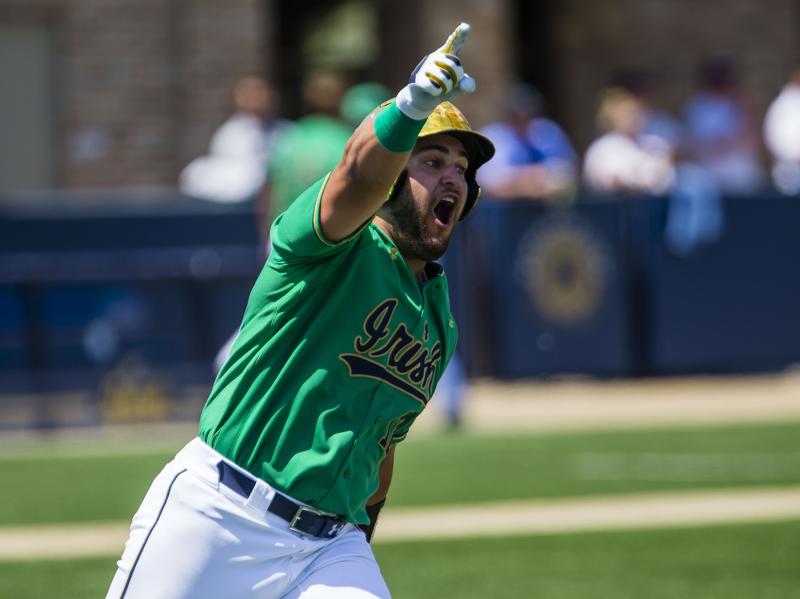
(Picture of Niko Kavadas: Kelly O’Connor/sittingstill.smugmug.com)
Red Sox’ 11th-round pick Niko Kavadas identified by Baseball America as underrated draft selection

Of the 15 college players the Red Sox selected in the 2021 MLB first-year player draft this week, 10 attended schools that are in Power Five conferences (the ACC, Big 12, Big 10, Pac-12, and SEC).

While the likes of University of Florida outfielder Jud Fabian stick out in regards to big names Boston took from the college ranks in this year’s draft, their 11th-round selection has garnered some attention as well.

To kick off the third and final day of the draft on Tuesday, Boston took University of Notre Dame first baseman Niko Kavadas with the 316th overall pick.

Kavadas, 22, was regarded by Baseball America as the 158th-ranked draft-eligible prospect coming into the week, and one BA writer in particular views the Fighting Irish slugger as perhaps the most underrated member of Boston’s 20-man draft class.

“Calling Kavadas underrated seems odd considering he was one of the best and most successful players in college this year,” Baseball America’s Ben Badler wrote on Wednesday. “But he was an 11th-round pick, so he fits the bill. Kavadas has massive power and he draws walks. That’s pretty much the extent of his plus tools, but it’s a very important skill and one that can carry a player all the way to the big-leagues.”

In his senior season for Notre Dame this spring, Kavadas — an Indiana native — produced a slash line of .302/.473/.767 with eight doubles, 22 home runs, 64 RBI, 42 runs scored, two stolen bases, 50 walks, and 55 strikeouts over 47 games (220 plate appearances).

While Kavadas is known for what he can do at the plate, there is some concern regarding the left-handed hitter’s defensive range as well as his speed on the base paths.

Per his Baseball America scouting report from earlier this year, Kavadas “is a well below-average runner with limited range who will be limited to first base or DH at the next level. He has the raw power to profile there and he can send the ball out of the park in any direction, and he did a nice job getting into hitter’s counts and then hammering fastballs this spring.

“He did struggle more against breaking and offspeed stuff and was also less successful than scouts would have liked to see against 93-plus mph velocity, which are valid concerns for his pure hit tool at the next level.”

On top of that, Kavadas turns 23 in October, so he is a bit older than the prototypical college prospect. That being said — or as BA noted, “there’s real power for a team that thinks he’ll be able to regularly get to it at the next level with a wood bat.”

Red Sox amateur scouting director Paul Toboni seems to buy into this philosophy as well, as he told reporters (including The Boston Globe’s Alex Speier) on Tuesday that Kavadas’ power tool is at “the top of the scale” already.

“If he were in the major-leagues right now, my guess is that the power would line up with the best of them,” Toboni said. “He’s an interesting player and a great kid.”

Listed at 6-foot-1 and 235 pounds, it’s safe to say Kavadas is an intimidating presence when he steps in the batter’s box.

By taking Kavadas in the 11th round of this year’s draft, the Red Sox can sign the slugging corner infielder for up to $125,000 without tapping into their bonus pool total.

If they do exceed the $125,000 limit in order to sign Kavadas (which seems to be a legitimate possibility based off speculation within the industry), or any other Day 3 pick, that would require them to dip into their bonus pool.

As things currently stand, Boston has $11,359,600 in total bonus pool space to work with, though that cap could increase to approximately $11,927,580 if the club was willing to incur some tax-related penalties by surpassing the limit by up to 5%.

The Red Sox, like all major-league teams, will have until 5 p.m. eastern time on Sunday, August 1 to sign as many of their draft picks as possible, though Toboni did say he only expects 13-15 of the club’s draftees to actually sign.

(Picture of Niko Kavadas: Michael Caterina/South Bend Tribune via AP)